
Rhodonite Identifier —
Natural, Dyed, or Pink Simulant?
Upload a photo of your rhodonite — jewellery, carving, tumbled stone, or rough — and our AI identifies the stone, assesses the characteristic black manganese oxide veining, distinguishes rhodonite from rhodochrosite and rose quartz, and flags common pink simulants. Free, no sign-up required.
What You Get in Every Result
- Rhodonite verdict — Natural / Dyed / Simulant
- Confidence percentage with full visual reasoning
- Variety — Massive rhodonite, Fowlerite, Gem-quality transparent
- Black veining assessment — manganese oxide pattern quality
- Distinction from rhodochrosite, rose quartz, thulite, morganite
- Geographic origin indicators — Russia, Australia, USA, Sweden, Peru
- Collector value and rarity assessment
- Care instructions for a relatively soft stone
Rhodonite Identifier
Identify rhodonite (pink manganese silicate) vs rhodochrosite, pink opal, dyed stones, and glass
Drag & drop photos here
or click to browse
JPG, PNG, WEBP accepted
0 of 3 images added
Add details for better accuracy (optional)
Upload up to 3 angles for the most accurate result
Description
Origin / formation
Is Rhodonite
Type hint
Black veining
Texture
vs look-alikes
Dye / treatment
Hardness (Mohs)
Luster
Rarity
Relative value
Notable localities / regions
Typical colours
Key properties
Similar minerals
Alternative identifications
Note: Rhodonite vs rhodochrosite and dyed stones often needs hardness/SG checks and magnification for dye in cracks. Photo ID is a starting point, not an appraisal.
What Is Rhodonite — The Pink Stone with Black Veins
Rhodonite is a manganese inosilicate mineral — (Mn,Fe,Mg,Ca)SiO₃ — belonging to the pyroxenoid group. Its name comes from the Greek rhodon (rose), reflecting its characteristic rose-pink to deep raspberry-red colour, which is caused by manganese in the crystal structure. It is the manganese that colours both the pink of the mineral itself and the black manganese oxide (typically pyrolusite or other Mn-oxides) that forms the characteristic dark veining seen in most rhodonite specimens.
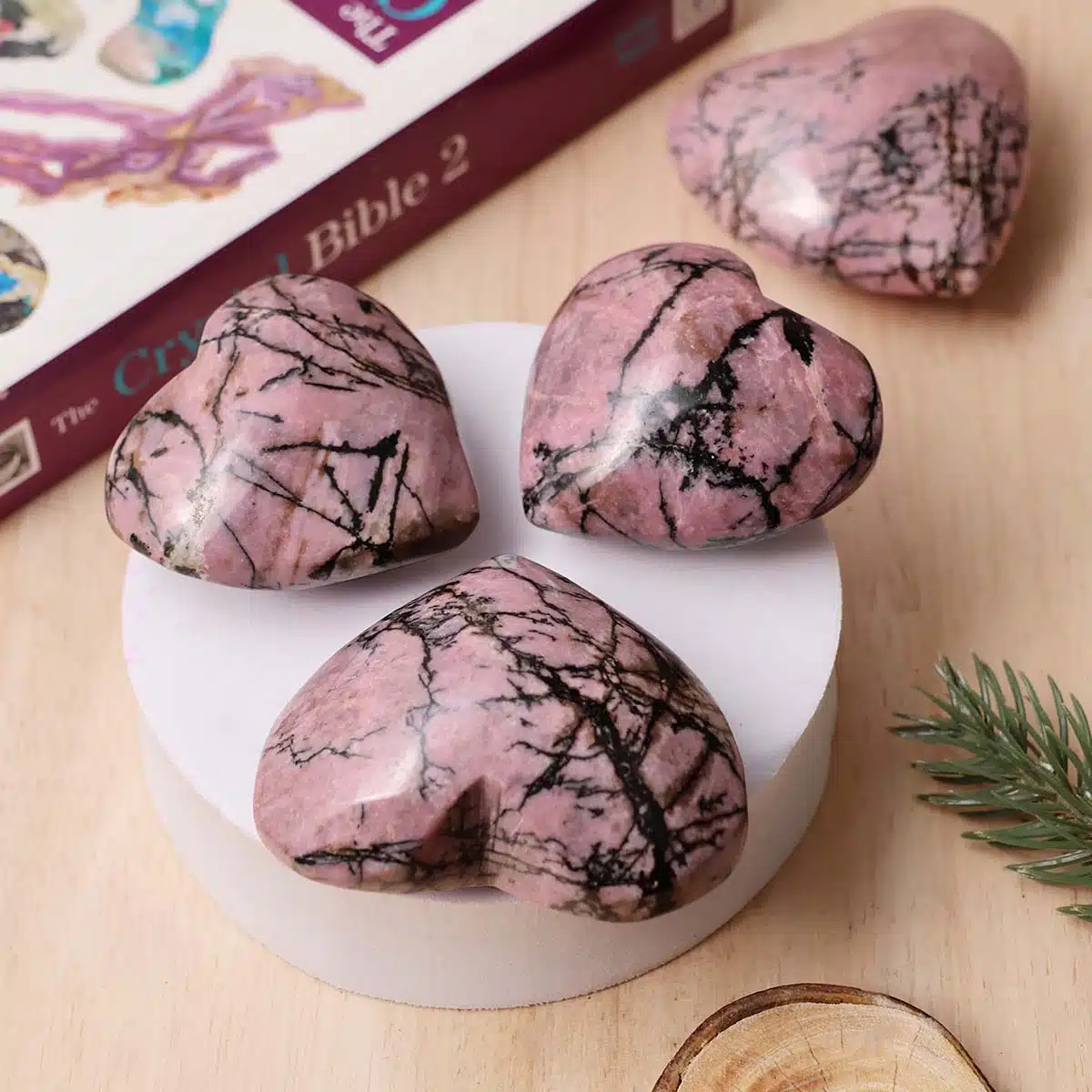
The black veining is rhodonite’s most visually diagnostic feature and the characteristic that most distinguishes it in photographs. The pink body with irregular black veins and patches — sometimes fine and delicate, sometimes bold and dramatic — is essentially unique to rhodonite among common pink gemstones. No other widely available pink mineral shows this specific combination of vivid rose-pink groundmass with black manganese oxide dendritic or vein patterns.
Rhodonite vs rhodochrosite — the most important pink mineral confusion
Rhodonite and rhodochrosite are both manganese-bearing pink minerals, both named from the Greek for rose, and both used as gemstones and ornamental materials. Despite sharing a name root and a colouring element, they are completely different minerals with very different properties — rhodonite is a silicate (Mohs 5.5–6.5) while rhodochrosite is a carbonate (Mohs 3.5–4.5, and reacts to acid). The distinction matters enormously in care — rhodochrosite is damaged by acids found in cosmetics and household cleaners; rhodonite is significantly more resistant. Our AI clearly distinguishes between them.
Rhodonite vs Rhodochrosite — A Detailed Comparison
These two pink manganese minerals are confused more than any other pair in the pink gemstone category. Here is a side-by-side comparison of all key properties:
The acid test — definitive separation in 10 seconds
The single fastest and most definitive test to distinguish rhodonite from rhodochrosite is the acid test. Apply a drop of dilute hydrochloric acid (or household white vinegar) to an inconspicuous area. Rhodochrosite is a carbonate — it fizzes and bubbles immediately as the acid reacts with its calcium carbonate structure, just like limestone or marble. Rhodonite is a silicate — it does not react at all to dilute acid. This test works in 10 seconds and gives a definitive result. Always test on a hidden area, as acid can etch polished surfaces.
“The confusion between rhodonite and rhodochrosite is one of the most commercially consequential in the pink mineral market. Rhodochrosite — particularly the fine banded stalactitic material from Argentina — commands dramatically higher prices per kilogram than rhodonite. Getting the identification wrong in either direction matters: rhodonite sold as rhodochrosite is fraud; rhodochrosite sold as rhodonite is leaving significant money on the table.”
The Pink Mineral Family — Where Rhodonite Sits
Pink gemstones come from a surprisingly diverse range of mineral families. Understanding where rhodonite sits in this landscape helps with identification and contextualises the comparison our AI makes in every result.
Rhodonite Varieties — From Massive Ornamental to Rare Gem-Quality
Rhodonite occurs in several distinct forms, each with different visual character, value, and collector appeal:
- Massive ornamental rhodonite. The most commonly encountered form — opaque pink to rose-red material with dramatic black manganese oxide veining. Used for cabochons, carvings, beads, and decorative objects. Russian rhodonite — particularly from the Ural Mountains — is the historical benchmark for this variety, producing enormous pieces used in Imperial Russian decorative arts. The bold contrast of vivid pink against black veining makes this material immediately recognisable.
- Fowlerite. A zinc-bearing variety of rhodonite — named for American chemist John Fowler — with a characteristic pale rose to flesh-pink colour and somewhat higher transparency than typical massive rhodonite. Found primarily at Franklin Furnace, New Jersey, USA — one of the world’s most famous mineral localities. Fowlerite often shows bright orange-red fluorescence under UV light, which is a distinctive and diagnostic property.
- Gem-quality transparent rhodonite. The rarest form — transparent to semi-transparent rhodonite that can be faceted into gemstones showing the rose-red colour without the usual black veining. Found occasionally in Sweden (Langban), Australia (Broken Hill), and Brazil. Transparent faceted rhodonite is among the rarer collector gemstones — fine examples command significant premiums at mineral shows and gemstone auctions.
- Rhodonite with matrix. Specimens showing rhodonite crystals on or within their host rock matrix — calcite, quartz, or skarn minerals. Well-formed rhodonite crystals are themselves collectors’ items; the tabular crystal form with distinct pink colour is attractive. Large rhodonite crystals from Peru and from the Broken Hill deposit in New South Wales, Australia are particularly prized by mineralogists.
Fowlerite UV fluorescence — a distinctive identification tool
The zinc-bearing Fowlerite variety from Franklin Furnace, New Jersey shows a distinctive bright orange-red fluorescence under shortwave UV light — a property caused by the zinc content activating fluorescence in the manganese-coloured mineral. Standard rhodonite without significant zinc content typically does not show this fluorescence. If you have a pink mineral that fluoresces orange-red under UV, Fowlerite from the Franklin district is a strong candidate. Franklin Furnace is one of the world’s most fluorescent mineral localities — many of its minerals glow vividly under UV in multiple colours simultaneously.
Rhodonite Origins — The World’s Major Deposits
| Origin | Characteristic Type | Key Feature | Collector Status |
|---|---|---|---|
| Ural Mountains, Russia | Massive ornamental — bold pink-black | The historic Imperial source. Produced enormous blocks for Fabergé objects, decorative panels, and the famous rhodonite sarcophagus of Empress Maria Feodorovna. The Russian material set the standard for bold contrast between vivid pink and dramatic black veining | Historic benchmark |
| Broken Hill, NSW, Australia | Massive + rare gem-quality transparent crystals | One of the world’s finest rhodonite localities. Produces both ornamental material and rare transparent facetable crystals. The Broken Hill deposit is a classic skarn environment associated with zinc-lead ore | Premier collector quality |
| Franklin Furnace, NJ, USA | Fowlerite — zinc-bearing, UV fluorescent | The world’s most famous mineral fluorescence locality. Fowlerite here shows brilliant orange-red UV fluorescence. Associated with the extraordinary Franklin-Sterling Hill fluorescent mineral assemblage | Iconic mineral locality |
| Sweden (Langban, Pajsberg) | Gem-quality crystals, some transparent | Classic European mineral localities producing well-formed rhodonite crystals and occasional gem-quality transparent material. Langban is among Sweden’s most important mineral sites | Collector crystals |
| Peru | Large crystals on matrix | Produces impressive large rhodonite crystals on calcite or quartz matrix. Commercial ornamental material and some collector specimens. Important modern commercial source | Good commercial + crystals |
| USA (Massachusetts, Montana) | Massive ornamental, some gem material | Cummington, Massachusetts was an early American source. Montana produces commercial material. The Massachusetts material is where rhodonite was first formally described in American mineralogy | Commercial — historical |
Rhodonite Look-Alikes — The Pink Stone Confusions
Rhodonite in History — Imperial Russia and Australian Heritage
- Imperial Russia. The Ural Mountains rhodonite deposits were discovered in the 18th century and became one of the most important decorative stones in the Russian Imperial tradition. Peter Carl Fabergé used Ural rhodonite in his decorative objects — boxes, frames, and objets d’art — alongside the malachite, jasper, and nephrite for which Russian Imperial craftsmanship is famous. The most extraordinary use of rhodonite in Russian history is the sarcophagus of Empress Maria Feodorovna (mother of Tsar Nicholas II), carved from a single massive block of Ural rhodonite and displayed in the Peter and Paul Cathedral in St Petersburg.
- Australia’s national gemstone status. In New South Wales, rhodonite from the Broken Hill district has been proposed at various times as a state gemstone — reflecting both the quality of the material and its cultural association with the famous mining heritage of western NSW. The Broken Hill deposit produces some of the world’s finest rhodonite alongside the zinc-lead ores that made the city famous.
- Massachusetts State Gem. Rhodonite was designated the official state gem of Massachusetts in 1979 — honouring the Cummington deposit, which was the type locality where rhodonite was first formally described and named in North America. The designation reflects both the geological significance of the deposit and the attractive pink stone’s appeal as a state symbol.
- Name and discovery. Rhodonite was first described and named in 1819 by German geologist Christoph Friedrich Jasche, who named it from the Greek rhodon (rose) for its distinctive colour. It was initially found in the Ural Mountains region and quickly attracted attention from both collectors and the decorative arts industry for its bold and distinctive appearance.
Rhodonite Care — A Moderately Practical Stone
Rhodonite’s moderate hardness (Mohs 5.5–6.5) and cleavage in two directions make it a stone that requires some care, particularly in rings. Here is what to know:
- Hardness. At Mohs 5.5–6.5, rhodonite is harder than rhodochrosite, calcite, and many soft minerals, but softer than quartz (7), topaz (8), and sapphire (9). Ordinary dust and grit contain quartz particles that can scratch rhodonite surfaces over time. Store separately from harder gems and clean gently.
- Cleavage. Rhodonite has perfect cleavage in two directions — it can split along flat planes from a sharp knock in the right direction. This makes it more fragile than a non-cleavage mineral of equivalent hardness. Protective settings and careful handling reduce risk.
- Acid resistance. Unlike rhodochrosite, rhodonite does not react to dilute acids — it is a silicate, not a carbonate. This means it is safe in contact with mild household cleaners and is not damaged by perfume or perspiration to the degree that rhodochrosite is. Still, avoid harsh chemical cleaners.
- Cleaning. Clean with a soft damp cloth or mild soap and lukewarm water. No ultrasonic or steam cleaning — the vibration can stress existing cleavage planes and cause internal fracturing. Dry thoroughly after cleaning.
- Best settings for jewellery. Rhodonite works best in pendants, earrings, and brooches where impact risk is minimal. Ring settings should be protective — a bezel setting guards the stone’s girdle from side impacts. Remove rhodonite rings before physical work.
Frequently Asked Questions
Have Rhodonite to Identify?
Upload your photo above for an instant AI assessment — or explore our full range of identifier tools below.
Identify My Rhodonite ↑