
Meteorite Identifier —
Did You Find a Space Rock?
Upload a photo of your suspected meteorite. Our AI screens for the key visual properties that distinguish genuine meteorites from common Earth rocks — fusion crust, regmaglypts, metallic flecks, and more. Get an honest assessment with confidence scoring in seconds.
What You Get in Every Result
- Meteorite likelihood verdict — Definite / Very Likely / Possible / Unlikely / Definitely Not
- Confidence percentage with detailed visual reasoning
- Probable meteorite classification — stony, iron, or stony-iron
- Fusion crust assessment — presence, condition, and coverage
- Regmaglypt and surface texture analysis
- Common Earth rock alternatives that match appearance
- Recommended next steps — magnet test, window test, expert contacts
- Collector value indication and how to proceed if genuine
Meteorite Identifier
Upload photos of suspected meteorites — outside, broken face, and scale if possible. AI assesses fusion crust, shape, and common look-alikes (not a lab verdict).
Drag & drop photos here
or click to browse
JPG, PNG, WEBP accepted
0 of 3 images added
Add details for better accuracy (optional)
Upload up to 3 angles for the most accurate result
Description
Origin / formation
Hardness (Mohs)
Luster
Rarity
Relative value
Notable localities / regions
Typical colours
Key properties
Similar meteorites
Alternative identifications
What Our Meteorite Identifier Analyses
Genuine meteorites have a very specific set of visual properties formed during their violent entry through Earth’s atmosphere and their origin in space. When you upload a photo, the AI examines every visible feature against the known characteristics of confirmed meteorites — and equally importantly, against the most common Earth rocks that are mistaken for meteorites.
Important — this is a screening tool, not a classification
Definitive meteorite identification requires physical examination, nickel testing, and in most cases laboratory analysis by a qualified meteoriticist. Our tool provides a photograph-based screening assessment that tells you whether your specimen is worth submitting for professional examination. If our tool rates your specimen as “Possible” or higher, follow up with the next steps provided in your result.
The Three Main Types of Meteorite
Meteorites are classified into three broad groups based on their composition and the type of parent body they originated from. Each group has distinct visual characteristics that our AI uses to suggest a probable classification alongside the overall likelihood assessment.
“The Widmanstätten pattern found in iron meteorites is the definitive proof of extraterrestrial origin. It forms only when an iron-nickel melt cools at roughly one degree per million years — a rate impossible to replicate on Earth, and one that tells you the metal cooled inside an asteroid core over billions of years.”
Common Meteorwrongs — Earth Rocks Mistaken for Meteorites
Meteorite hunters and enthusiasts use the term “meteorwrong” for Earth rocks that are mistaken for meteorites. The vast majority of specimens submitted to experts for identification turn out to be terrestrial. These are the most common culprits:
| Rock / Material | Why It’s Mistaken | How to Tell It Apart | How Common |
|---|---|---|---|
| Magnetite / Hematite | Heavy, dark, magnetic — ticks all the basic meteorite boxes | No fusion crust; often layered or banded; leaves red-brown streak | Very Common |
| Scoria / Volcanic Slag | Dark, heavy-looking, sometimes with a glassy exterior | Vesicles (gas holes) throughout — meteorites never have these | Very Common |
| Industrial Slag | Heavy, dark, metallic-looking, sometimes with fusion-like exterior | Irregular bubbly texture; often shows molten flow patterns | Very Common |
| Pyrite Nodules | Heavy, metallic, sometimes rounded | Brassy colour when fresh; distinctive cubic crystals; black streak | Common |
| Limonite Concretions | Rounded, brown-black, sometimes with rough exterior | Light weight; earthy texture inside; red-yellow streak | Common |
| Basalt | Dark, dense, occasionally rounded | Contains visible plagioclase feldspar; often has gas vesicles | Common |
| Man-Made Objects | Iron or steel fragments, cannon balls, old tools — heavy and metallic | No fusion crust; machined edges; no Widmanstätten pattern when cut | Common |
The bubble test — fastest single elimination
Look very carefully at your specimen’s surface under a strong light, and examine any broken surfaces. If you can see any tiny holes, cavities, or vesicles — even very small ones — the specimen is not a meteorite. Meteorites are formed in the vacuum of space and have no gas bubbles whatsoever. This single observation eliminates the majority of volcanic and industrial look-alikes immediately.
Fusion Crust — The Most Important Visual Feature
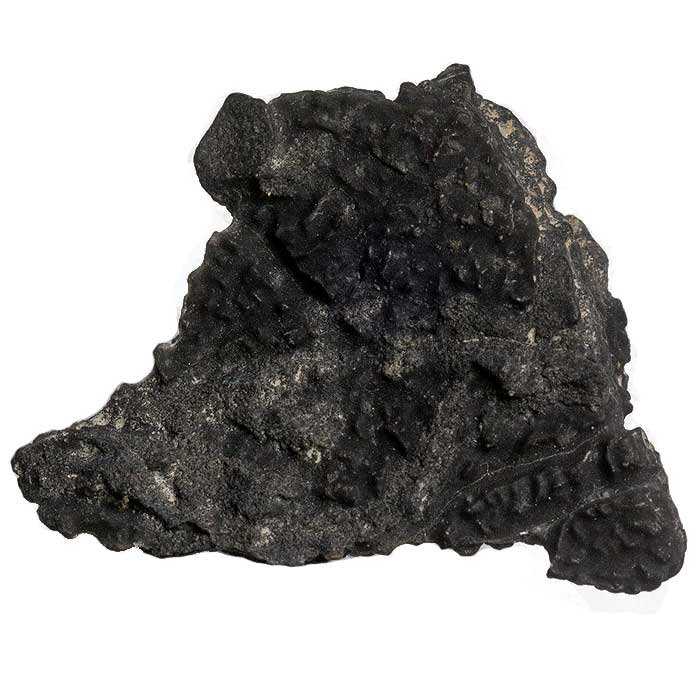
Fusion crust is the thin, dark, glassy coating formed on the exterior of a meteorite as it heats to several thousand degrees during atmospheric entry. It is the single most diagnostic visual feature of a freshly fallen meteorite and one of the most important things to look for in your photos.
- Colour and texture. Fresh fusion crust is jet black to dark brown, slightly shiny to matte, and very thin — typically less than 1mm. It often shows a flow texture, oriented parallel to the direction of flight through the atmosphere.
- Coverage. Complete fusion crust covers the entire exterior of the stone. Oriented meteorites — those that maintained a consistent orientation during flight — develop a more pronounced crust on the leading face and a thinner crust on the trailing side.
- Weathering. Fusion crust weathers over time. Older meteorites found after long periods on the ground develop a brown or reddish oxidation weathering rind over the crust. This can make identification harder — but the underlying crust structure is often still detectable.
- Flow lines and rollover lips. Look for subtle lines on the crust surface showing the direction of airflow during atmospheric entry. Where the crust wraps around edges, it sometimes forms a slightly thickened rim called a rollover lip — a strong positive indicator.
How to photograph fusion crust effectively
Photograph in strong raking light — a single light source at a low angle across the surface — to bring out the texture of the crust. This type of lighting reveals the subtle flow texture, regmaglypts (thumbprint impressions), and rollover lips that flat overhead lighting completely obscures. Include a close-up of any area where the crust appears different from the surrounding surface — transitions between crust and broken interior are highly diagnostic.
At-Home Meteorite Tests — Before Submitting to an Expert
Before going to the expense and effort of professional laboratory identification, these simple home tests will help you determine whether your specimen is worth pursuing further. A genuine meteorite candidate should pass most of these tests.
Where Meteorites Are Found
Meteorites fall randomly across the entire surface of the Earth, but certain environments make them far easier to find and identify. The location where you found your specimen provides useful context for our AI’s assessment.
Context that significantly improves our assessment
If you found your specimen in a known meteorite strewn field, a desert environment, or an area with documented past meteorite falls, please mention this in the optional context field when submitting your identification. Location, the circumstances of the find (surface find vs buried), and whether the specimen attracted a magnet are the three most useful pieces of additional information you can provide.
Frequently Asked Questions
Think You Found a Space Rock?
Upload your photos above for an honest AI screening assessment — or explore our other rock and mineral identification tools below.
Screen My Specimen ↑