
Agate Identifier —
What Type of Agate Is This?
Upload a photo of your agate, banded stone, or chalcedony specimen. Our AI identifies the agate type, assesses banding quality, flags dyed or synthetic imitations, and gives you a complete mineral profile — free, no sign-up, results in seconds.
What You Get in Every Result
- Agate type identification with confidence percentage
- Natural vs dyed vs synthetic assessment
- Banding pattern description and quality grade
- Chalcedony sub-type and formation notes
- Mohs hardness, luster, and transparency
- Common global locations and geological formation
- Collector value and market demand indication
- Similar stones and how to distinguish them
- Care instructions and polishing recommendations
Agate Identifier
Identify banded agate, moss agate, carnelian, onyx, and common look-alikes
Drag & drop photos here
or click to browse
JPG, PNG, WEBP accepted
0 of 3 images added
Add details for better accuracy (optional)
Upload up to 3 angles for the most accurate result
Description
Origin / formation
Is Agate
Variety
Banding / pattern
Translucency
Treatment likelihood
Probable origin
Hardness (Mohs)
Luster
Rarity
Relative value
Notable localities / regions
Typical colours
Key properties
Similar materials
Alternative identifications
Note: Photo-based identification cannot replace laboratory testing for valuable stones.
What Is Agate — and Why Is Identification Tricky?
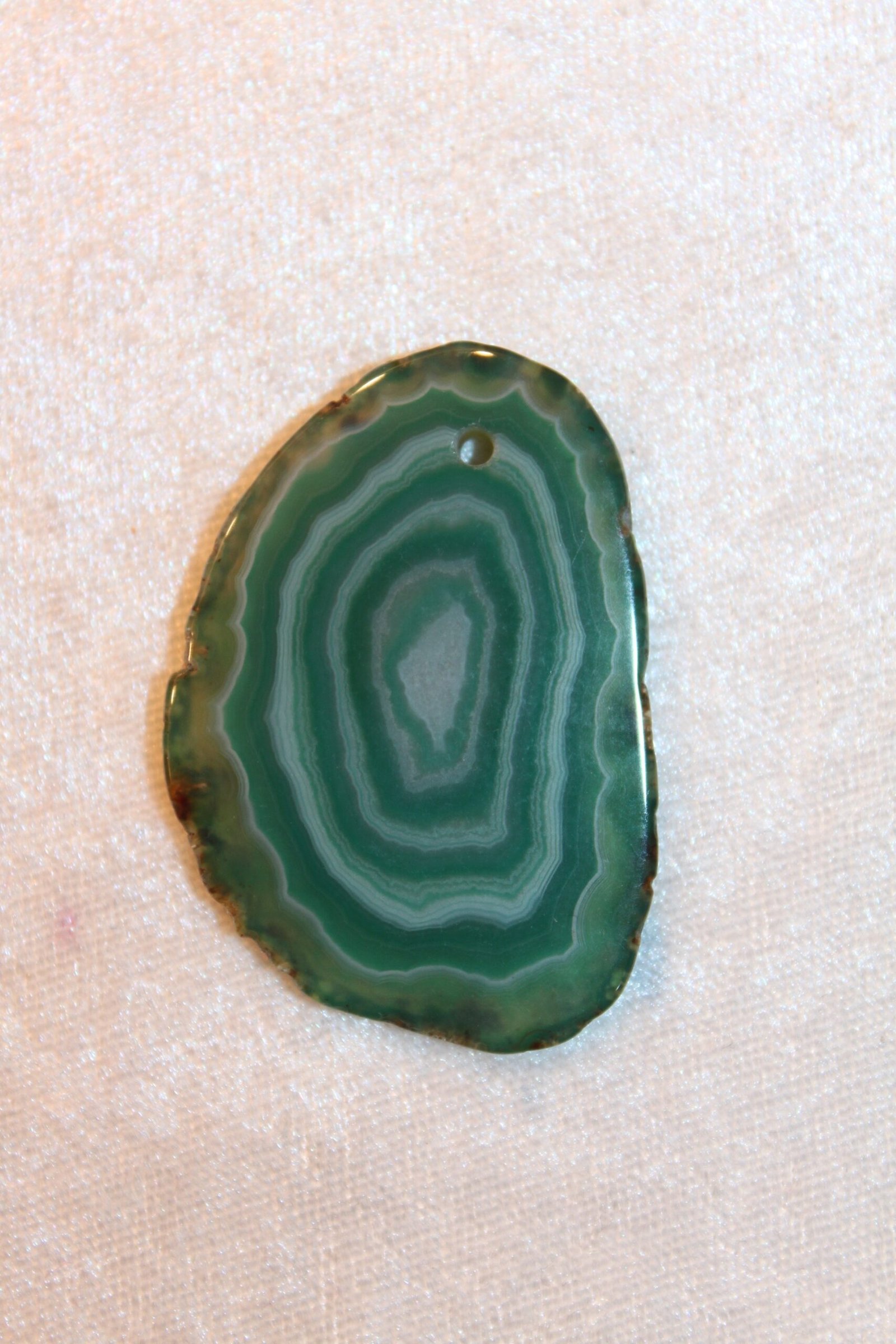
Agate is a banded variety of chalcedony — itself a microcrystalline form of quartz (SiO₂). It forms when silica-rich fluids slowly infiltrate cavities in volcanic rock, depositing successive layers of microcrystalline quartz that create the characteristic concentric banding pattern agates are famous for. The colour of each band is determined by trace mineral impurities present in the silica fluid at the time of deposition.
What makes agate identification genuinely challenging is the enormous variety within the family. Over 30 named agate varieties exist, each with different banding patterns, colour combinations, and inclusion types. On top of this, agate is one of the most heavily dyed and treated stones in the gem and collector market — a significant proportion of commercially available agates have been artificially coloured. Our AI analyses banding geometry, colour distribution, surface texture, and translucency to identify the variety and flag treatments.
The chalcedony family — where agate fits
Agate belongs to the chalcedony family of microcrystalline quartz. Chalcedony is the parent mineral — when it shows distinct banding, it is called agate. When it is uniformly coloured without banding, it is called chalcedony (or given a specific name based on colour: carnelian is red-orange chalcedony, chrysoprase is green, onyx is black and white banded). Understanding this helps you interpret your result — our tool identifies both the specific agate type and the broader chalcedony variety context.
Agate Varieties Our AI Identifies
Each named agate variety has a distinctive combination of banding pattern, colour, inclusion type, or formation characteristic that distinguishes it from others. Here are the most commonly encountered types:
Natural vs Dyed Agate — How to Tell Them Apart
Agate is one of the most commonly dyed stones in the gem and collector market. Its naturally porous microcrystalline structure absorbs dye readily, and many commercial agates — particularly the vivid blue, green, red, and black specimens sold in gift shops and online — have been artificially coloured. This does not make them worthless, but it does affect value significantly and is important to disclose.
“The single biggest tell for dyed agate is colour concentration in fractures. Natural colour distributes evenly through the chalcedony structure. Dye penetrates along the easiest pathways — fractures and porous zones — and concentrates there visibly. Look for darker lines exactly where cracks run.”
Agate vs Common Look-Alikes
Several other stones are commonly confused with agate, either because they share the chalcedony base mineral or because they have superficially similar banding or patterning. Here is how to distinguish each:
| Look-Alike | Why It’s Confused | Key Difference from Agate | How Common |
|---|---|---|---|
| Onyx | Also banded chalcedony in black and white | Parallel straight banding (not concentric); used interchangeably by many traders | Very Common |
| Jasper | Also a microcrystalline quartz, similar hardness | Opaque throughout; no translucency; no distinct banding — mottled or spotted | Very Common |
| Chalcedony | Parent mineral — identical composition | Uniform colour without banding; no concentric structure visible | Very Common |
| Fluorite | Can show banding and similar colour ranges | Much softer (Mohs 4 vs 7); perfect octahedral cleavage; heavier feel | Moderate |
| Aragonite | Can show banded structure (banded calcite/aragonite) | Softer (Mohs 3.5); reacts to acid; heavier; wavy irregular banding | Moderate |
| Glass (Slag) | Can be moulded to show banding; sold as agate | Bubbles or swirls internally; uniform banding too perfect; no conchoidal grain | Moderate in trade |
| Rhodonite | Pink and black banding superficially similar | Coarser grain visible; black manganese oxide veins not concentric bands; softer | Less Common |
The translucency test
Agate is typically translucent to semi-translucent — hold a thin slice up to a strong light source and light passes through, glowing warmly through the bands. Jasper is completely opaque and transmits no light. This single test distinguishes agate from jasper immediately, even without any other equipment. Many specimens sold as “agate” are actually jasper; the distinction matters for both value and identification.
How Agate Forms — The Science Behind the Bands
Understanding how agate forms helps explain the enormous variety of patterns and colours found across different specimens, and gives important context for interpreting your identification result.
- Volcanic cavity origin. Most agates begin as gas bubbles in cooling lava. These spherical to irregular cavities — called vesicles — are gradually filled with silica-rich groundwater percolating through the rock. The process can take millions of years.
- Layer-by-layer deposition. Silica is deposited as successive thin layers on the walls of the cavity, working inward. Each layer represents a different episode of fluid chemistry, explaining why colours change from band to band. Some agates preserve hundreds of distinct bands within a few centimetres.
- Colour from trace minerals. Iron oxides produce red, orange, and yellow bands. Manganese oxides produce black and brown bands. Chlorite inclusions produce green. Titanium and other elements produce blue tints. Pure silica with few impurities produces the white and translucent bands that alternate with coloured layers.
- Nodule formation. The filled cavity gradually becomes isolated from its host rock — the vesicle-filling agate nodule can eventually weather out as a separate rounded stone. This is why agates are commonly found as rounded nodules in riverbeds and gravel deposits.
- Fortification vs parallel banding. When silica deposits follow the shape of the original cavity wall, the banding is concentric — this produces the classic fortification pattern. When deposition occurs in horizontal layers (often in larger cavities), the banding is parallel and horizontal — these are classified as onyx rather than agate.
Why some agates have hollow centres
When silica deposition stopped before completely filling the cavity, the interior remains hollow — this is a geode. Geodes with agate or chalcedony walls and quartz or amethyst crystal interiors are extremely common and widely collected. Our AI identifies both the outer chalcedony/agate banding and any visible crystal interior when both are shown in the photograph.
How to Photograph Agate for Best Identification Results
Agate’s banding and internal structure are best captured with specific photographic techniques. These four tips consistently improve identification accuracy:
Frequently Asked Questions
Have an Agate to Identify?
Upload your photos above for an instant AI identification — or explore our full range of identifier tools below.
Identify My Agate ↑