
Malachite Identifier —
Natural Banding or Imitation?
Upload a photo of your malachite — jewellery, carving, slab, sphere, or rough — and our AI assesses the banding pattern, colour saturation, and surface features to identify genuine malachite, distinguish it from green simulants, and flag dyed or synthetic material. Free, no sign-up required.
What You Get in Every Result
- Malachite verdict — Natural / Synthetic / Simulant
- Confidence percentage with full visual reasoning
- Variety — Botryoidal, Stalactitic, Velvety, Azurite-Malachite, Chrysocolla-Malachite
- Banding pattern quality — concentric, eye, peacock, ribbon
- Associated copper minerals identified — azurite, chrysocolla, cuprite
- Geographic origin indicators — Congo, Russia, Australia, Arizona
- Synthetic / dyed simulant identification
- Collector value, toxicity note, and care instructions
Malachite Identifier
Identify malachite (banded copper carbonate) vs chrysocolla, azurite mixes, dyed stones, and glass
Drag & drop photos here
or click to browse
JPG, PNG, WEBP accepted
0 of 3 images added
Add details for better accuracy (optional)
Upload up to 3 angles for the most accurate result
Description
Origin / formation
Is Malachite
Banding / pattern
Luster / texture
Copper context
vs look-alikes
Synthetic / glass
Probable origin
Hardness (Mohs)
Luster
Rarity
Relative value
Notable localities / regions
Typical colours
Key properties
Similar minerals
Alternative identifications
Note: Malachite vs dyed stone or resin often needs hardness checks and lab ID for valuable pieces. Avoid inhaling dust if cutting. Photo ID is a starting point, not an appraisal.
What Is Malachite — The Banded Green Copper Mineral
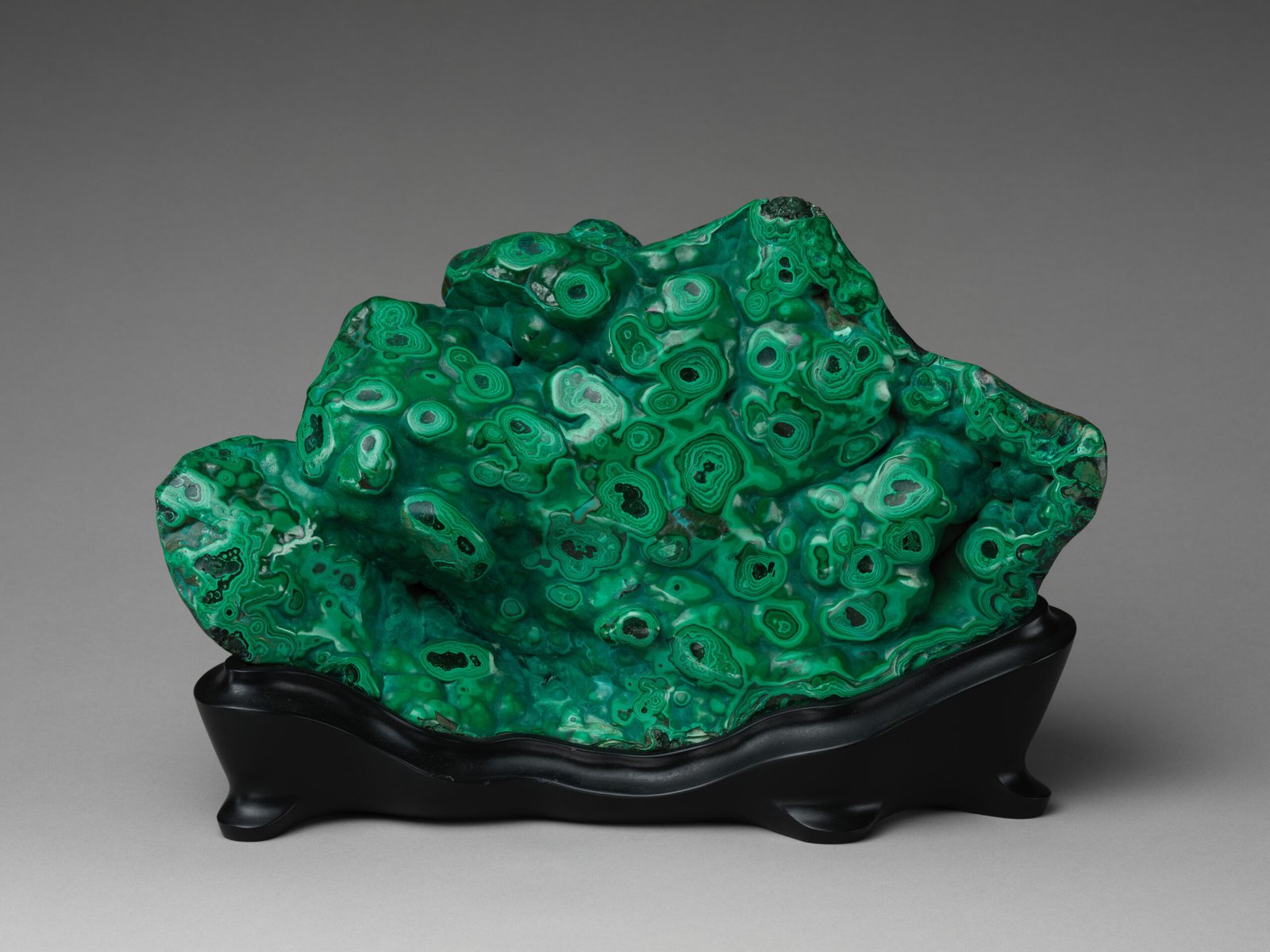
Malachite is a copper carbonate hydroxide mineral — Cu₂(CO₃)(OH)₂ — and one of the most visually distinctive minerals on Earth. Its vivid green colour, caused entirely by its copper content, ranges from bright emerald green to deep forest green, and its characteristic concentric banding — formed as the mineral grew in layered rings around a centre point — makes it instantly recognisable to anyone familiar with it.
Unlike most gemstones, malachite almost never forms in transparent single crystals large enough to facet. Instead, it grows as fibrous, botryoidal (grape-like), or stalactitic masses in the oxidised zones of copper ore deposits — where circulating acidic groundwater reacts with copper sulphide ores (like chalcopyrite) to produce secondary copper carbonates. The banding visible in polished malachite represents successive growth layers, each slightly different in colour and texture, laid down over thousands or millions of years.
Why malachite’s banding is the key identification feature
Natural malachite’s banding is organic and irregular — the bands curve, widen, narrow, split, merge, and vary in intensity in ways that cannot be precisely replicated by any manufacturing process. This natural variability is the primary indicator of genuine malachite. Synthetic malachite, dyed green stone, and glass simulants all fail to replicate the specific character of natural banding: its curvature, the subtle colour variation between bands, and the fibrous or silky surface texture within each band. Our AI analyses banding character as the primary diagnostic feature.
Malachite Banding Patterns — What Determines Quality and Value
The specific character of malachite’s banding determines both its visual appeal and its collector value. Our AI identifies banding pattern type as part of every result. The most prized patterns are the rarest and most geometrically striking:
“A perfect malachite eye — concentric rings of alternating light and dark green radiating from a single centre point, cut from the heart of a stalactite — is one of the most geometrically perfect natural objects in mineralogy. Each ring represents a period of growth. The cross-section of a stalactite is a record of geological time, rendered in green.”
The Copper Mineral Family — Malachite’s Close Relatives
Malachite forms in the oxidised zone of copper deposits alongside a community of closely related copper minerals, each with its own distinctive colour and character. These minerals often occur together on the same matrix specimen — understanding the family helps with identification and enriches the context of any malachite find.
Malachite Origins — The World’s Great Deposits
Malachite occurs wherever copper deposits have been exposed to oxidising groundwater — but certain deposits have produced exceptionally fine material that defined the collector and decorative arts market for centuries.
| Origin | Characteristic Type | Key Feature | Status |
|---|---|---|---|
| DRC / Congo (Katanga) | All types — ribbon, eye, botryoidal, massive | The world’s dominant malachite source today. Produces the finest quality banded slabs for jewellery and decorative objects. Vivid, strongly contrasted banding. The Katanga copper belt is one of the richest copper provinces on Earth | Premier — finest commercial material |
| Russia (Ural Mountains) | Massive banded — ribbon and eye pattern | The historic premier source for 18th–19th century Russian Imperial decorative arts. Enormous blocks produced the Malachite Room in the Winter Palace, St Petersburg. The Ural deposits are now largely exhausted but historic Russian malachite remains in museums and collections worldwide | Historic — largely exhausted |
| Namibia (Tsumeb) | Azurite-malachite, fine crystals, botryoidal | The Tsumeb mine is one of the world’s great mineral localities — produced extraordinarily fine azurite-malachite combinations and rare mineral species. Now closed. Tsumeb specimens command significant collector premiums | Collector — mine now closed |
| Australia (Queensland, SA) | Botryoidal, massive, some banded | Several significant Australian copper deposits produce malachite. Mount Isa and Olympic Dam are associated localities. Quality varies but some fine banded material and collector specimens produced | Commercial — variable quality |
| USA (Arizona, Utah) | Azurite-malachite, chrysocolla-malachite | Bisbee (Arizona) produced legendary azurite-malachite specimens now held in major museum collections. Morenci, Globe, and other Arizona copper mines produced fine material. Most historic US mines now closed or inaccessible for collecting | Collector — historic US specimens prized |
| Morocco (Midelt) | Banded slabs, botryoidal | Significant commercial producer of banded malachite for the jewellery market. Midelt region produces good quality ribbon-banded material. Increasingly important commercial source alongside Congo | Good Commercial |
Natural vs Synthetic vs Simulant Malachite
While malachite is not as heavily faked as lapis lazuli or jade, the market contains synthetic material and various dyed simulants — particularly in beads, lower-end jewellery, and crystal healing markets. Here are the most important look-alikes:
The acid test for malachite — react or not?
Malachite is a carbonate mineral — like calcite and limestone — and fizzes immediately when a drop of dilute hydrochloric acid (or even vinegar) is applied to the surface. This reaction is diagnostic: a green stone claiming to be malachite that does not react to acid is not malachite. Dyed howlite and magnesite are also carbonates and will react, but genuine malachite’s banding character combined with the acid reaction confirms identity. Glass and quartz simulants do not react. Perform the acid test only on an inconspicuous area, as it leaves a small spot on the surface.
Malachite in History — Russian Imperial Grandeur and Ancient Pigment
Malachite has a rich history across several civilisations — both as a decorative material and as an important source of copper ore and pigment:
- Ancient Egypt. Malachite was one of the most important substances in ancient Egyptian culture. It was ground to produce green eye paint (kohl) — the characteristic green eye makeup seen in Egyptian art and worn daily for both cosmetic and protective purposes. Malachite was associated with Hathor, the goddess of beauty, and with the paradise of the afterlife — “the Field of Malachite.” The oldest malachite mine known, at Sinai, was worked from approximately 3400 BCE.
- The Malachite Room, Winter Palace. The most spectacular decorative use of malachite in history is the Malachite Hall of the Winter Palace in St Petersburg — built for Tsar Nicholas I between 1830 and 1837. Enormous columns and surfaces are covered in veneered malachite from the Ural Mountains, employing the “Russian mosaic” technique: thin slices of malachite carefully cut and fitted together so the banding appears continuous, creating the impression of massive solid malachite columns that would otherwise be impossible to produce.
- Russian mosaic technique. Because truly massive solid malachite is rare, Russian craftsmen developed the technique of cutting paper-thin malachite slices and fitting them like a jigsaw onto a stone substrate — matching the banding so precisely that the joins are invisible. This technique allowed the creation of large decorative objects — tables, vases, columns — that appear to be solid malachite. Many antique “malachite” objects are malachite veneer over a stone core.
- Green pigment. Ground malachite was used as a green pigment — “mountain green” or “verdigris” — from ancient Egypt through the Renaissance. It produces a warm, slightly yellowish green that was widely used in medieval manuscript illumination and panel painting. It is less stable than some pigments (it can blacken with age as it converts to copper oxide) but was widely available and inexpensive compared to rarer mineral pigments.
- Copper ore. Before the development of modern mining, malachite and azurite were among the most important copper ores — easily smelted and widely available at the surface of oxidised copper deposits worldwide. The Bronze Age began partly because of easy access to surface copper minerals like malachite. Many ancient copper mines were worked primarily for malachite and azurite rather than the deeper sulphide ores.
Malachite Safety and Care — The Copper Toxicity Consideration
Malachite is one of the few gemstone minerals that requires specific safety awareness for handlers. Its copper content means that malachite dust is toxic — and this has practical implications for lapidaries, carvers, and collectors who work with raw material.
⚠ Malachite dust is toxic — wet grinding and dust masks are essential
Malachite contains approximately 57% copper by weight. Copper is an essential trace element but becomes toxic at elevated exposures — particularly via inhalation of fine dust. When malachite is cut, ground, or polished dry, it produces fine dust containing copper carbonate particles that are harmful if inhaled. Anyone cutting, drilling, or grinding malachite must work wet (keeping the stone and blade continuously wet) and wear an appropriate dust mask or respirator. This is not a concern for normal jewellery wear or handling polished malachite — only for lapidary work with raw or rough material.
Safe Handling of Polished Malachite
Polished malachite jewellery and objects are safe for normal everyday handling and wearing. The copper is locked in a stable mineral structure and does not leach in normal conditions. The practical care considerations for polished malachite are about protecting the stone, not about toxicity:
- Acids. As a carbonate mineral, malachite reacts with acids — including dilute acids found in perspiration, perfume, hairspray, and household cleaners. Prolonged acid contact etches and dulls the polished surface. Avoid wearing malachite jewellery while cleaning, and apply cosmetics before putting on malachite pieces.
- Hardness. Malachite is soft (Mohs 3.5–4) — softer than a copper coin. It scratches very easily against harder materials, including dust and grit. Store malachite separately from harder stones; clean only with a soft damp cloth; avoid abrasive cleaners entirely.
- Water. Short contact with water is fine for cleaning, but prolonged soaking can affect some malachite — particularly material with existing fractures. Never use ultrasonic or steam cleaning, which can damage the surface and stress existing cracks.
- Heat. Malachite is sensitive to heat — it begins to decompose above approximately 250°C, releasing toxic copper oxide fumes. Do not use steam cleaning, and avoid exposing malachite jewellery to sustained direct heat sources.
Frequently Asked Questions
Have Malachite to Identify?
Upload your photo above for an instant AI assessment — or explore our full range of identifier tools below.
Identify My Malachite ↑