🟠 AI-Powered Citrine Identification

Citrine Identifier —
Natural, Heated Amethyst, or Simulant?

Upload a photo of your citrine — loose, set in jewellery, or rough — and our AI identifies whether it is natural citrine, heated amethyst sold as citrine, or a simulant such as yellow glass or synthetic material. Get colour grade, origin indicators, and treatment notes in seconds. Free, no sign-up required.

Free · No sign-up Natural vs heated amethyst Madeira colour grade Ametrine identification Yellow topaz distinction

What You Get in Every Result

  • Citrine verdict — Natural / Heated Amethyst / Simulant
  • Confidence percentage with full visual reasoning
  • Colour grade — Lemon, Golden, Madeira, Palmeira, Bahia
  • Heat treatment indicators — reddish tips, artificial colour zoning
  • Ametrine detection — natural purple-yellow bicolour quartz
  • Simulant identification — yellow topaz, yellow glass, synthetic
  • Geographic origin indicators — Brazil, Bolivia, Madagascar, USA
  • Collector value and care advice
Citrine identifier

Citrine Identifier

Identify citrine (yellow quartz) vs heated amethyst, lemon quartz, glass, and other yellow gems

Drag & drop photos here

or click to browse

JPG, PNG, WEBP accepted

0 of 3 images added

Add details for better accuracy (optional)

Upload up to 3 angles for the most accurate result

Identification Confidence 0%

Low confidence — try uploading more angles or add details above.

Description

Origin / formation

Is Citrine (yellow quartz)

Natural vs heated

Colour

Quartz habit / form

Inclusions / zoning

vs look-alikes

Synthetic / glass

Probable origin

Hardness (Mohs)

Luster

Rarity

Relative value

Notable localities / regions

Typical colours

Key properties

    Similar gemstones

    Alternative identifications

    Authentication Tip

    Note: Natural citrine vs heated amethyst usually requires lab testing (trace elements, IR) or documented provenance. Photo ID is a starting point, not an appraisal.

    Collector tip

    What Is Citrine — and Why Is Most of It Heated Amethyst?

    Citrine is the yellow to orange-brown variety of quartz (SiO₂) — the same mineral species as amethyst, smoky quartz, rose quartz, and rock crystal. Its colour ranges from the palest lemon yellow to deep, rich amber orange-brown. Natural citrine is coloured by trace amounts of iron in the quartz structure — specifically Fe³⁺ (ferric iron) ions that absorb blue light and transmit yellow.

    Here is the critical market truth: naturally occurring citrine is genuinely rare. The vast majority of commercial citrine — probably 95% or more — is amethyst or smoky quartz that has been heat-treated to convert its colour to yellow or orange. When amethyst is heated to approximately 470–560°C, the purple colour centres (also caused by iron, but Fe⁴⁺) are transformed to yellow-orange Fe³⁺ centres. The transformation is permanent and the resulting colour is commercially sold as citrine. This treatment is so universal and so accepted that it is rarely disclosed at point of sale — but it matters for collectors who seek genuinely natural material.

    The “topaz” naming confusion — antique jewellery pitfall

    Throughout the 18th, 19th, and early 20th centuries, yellow quartz (citrine) was routinely called “topaz” in the jewellery trade — specifically “Madeira topaz,” “Palmeira topaz,” “Bahia topaz,” “Brazilian topaz,” and “Spanish topaz.” None of these are mineral topaz. If you have inherited jewellery described as “topaz” that appears yellowish-brown or golden, it is almost certainly citrine quartz rather than the harder, denser silicate mineral topaz. The names persist to this day and cause significant consumer confusion. Our AI distinguishes citrine from genuine topaz.

    Citrine Colour Grades — From Lemon to Deep Madeira

    Citrine’s colour is the primary value driver, and the market uses both descriptive grade names and origin-based trade names to classify the spectrum from pale yellow to rich amber-brown. The deeper, more saturated colours — particularly Madeira — command the highest premiums.

    Lemon Citrine
    Pale yellow
    The lightest citrine colour — very pale, almost colourless yellow. Typically natural or very lightly heated. Common from Brazil, Madagascar, and USA. Lower commercial value due to weak saturation, but preferred by collectors of natural material.
    Most affordable — often natural origin
    Golden Citrine
    Medium yellow-gold
    Warm medium golden yellow — the most commercially popular citrine colour. Good saturation without the reddish-brown of deeper grades. May be natural or heated amethyst. Brazil (Rio Grande do Sul) is a major source. Widely used in fashion jewellery for its accessible price and attractive colour.
    Good commercial value — widely available
    Madeira Citrine
    Named for Madeira wine colour
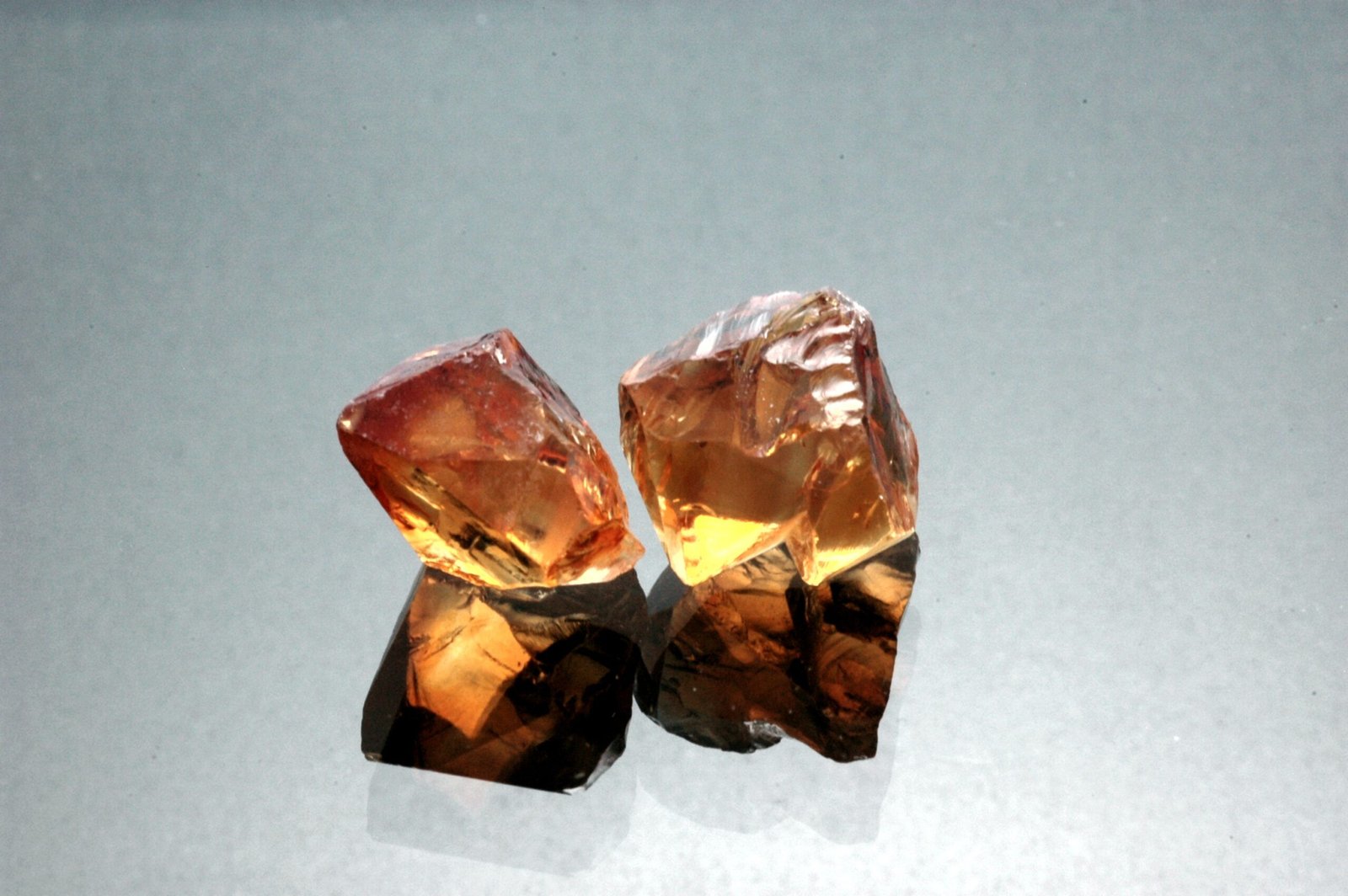
    The finest and most valuable citrine grade — a deep, rich orange-brown with reddish flashes, resembling the colour of Madeira wine. Almost always produced by heat treating amethyst — the characteristic reddish-brown comes from the transformation of purple colour centres. Collectors prize this colour most highly. Shows excellent fire in faceted stones.
    Highest value — most sought by collectors
    Palmeira Citrine
    Deep orange
    An intensely saturated orange grade — named for Palmeira in Brazil. Deeper and more orange than golden, without the brownish component of Madeira. The vivid pure orange is particularly striking in large faceted stones. Almost exclusively produced by heat treating amethyst from specific Brazilian localities.
    High value — vivid orange commands premiums
    Bahia Citrine
    Orange-red
    Named for the Bahia state of Brazil — a very intense, almost reddish-orange grade. The deepest citrine colour available. The intense reddish-orange is always heat-treated. Spectacular in large sizes where the depth of colour is most visible. Often confused with orange sapphire at first glance due to colour intensity.
    Premium grade — rare and visually dramatic
    Ametrine
    Bolivia only — bicolour
    The rarest quartz colour variety — a natural purple-and-yellow bicolour stone showing both amethyst and citrine colours in the same crystal. Found almost exclusively in the Anahi Mine of Bolivia. Not heat-treated — the bicolour is entirely natural. Faceted ametrine showing distinct 50/50 colour split is the most prized form.
    Collector value — natural bicolour from Bolivia

    “True Madeira citrine — the colour of aged Madeira wine, with its deep amber and reddish-brown flashes in a large faceted stone — is one of the most underrated colour gemstones in the market. It shows exceptional fire in strong light and an extraordinary warmth that no photograph fully captures. Despite being almost universally heat-treated amethyst, it is genuinely beautiful at prices far below equivalent ruby or imperial topaz.”

    Natural Citrine vs Heated Amethyst vs Simulants

    Understanding the three categories helps you interpret your AI result and make informed purchasing decisions. The value difference between natural citrine and heated amethyst is modest — but the difference between either and a glass simulant is significant.

    Natural Citrine
    Pale yellow to golden colour — iron (Fe³⁺) in the quartz structure
    Colour zoning typical — natural, irregular patches of stronger and weaker colour
    Hexagonal prism crystals with rhombohedral terminations
    Usually lighter and less saturated than heated material
    Commands modest collector premium over heated material
    Brazil (Minas Gerais), Madagascar, USA (Colorado)
    Heated Amethyst / Smoky Quartz
    Orange-brown to deep amber colour — temperature-transformed colour centres
    Reddish “fire tips” on crystal terminations are a key indicator
    Abrupt colour zones rather than gradual natural zoning
    May show whitish clouds or “breadcrumb” inclusions from heating
    Madeira, Palmeira, Bahia grades almost always this category
    Fully accepted — same mineral, different colour history
    Simulants
    Yellow glass — bubbles, lower hardness, conchoidal chips
    Yellow topaz — heavier (SG 3.53 vs 2.65), cleavage not fracture
    Yellow sapphire — dramatically heavier, much harder
    Yellow fluorite — much softer (Mohs 4), different cleavage
    Synthetic quartz — identical properties, no natural inclusions
    Coated quartz — iridescent coating wears at girdle

    The reddish tip indicator — fastest visual sign of heated amethyst

    The most reliable visual indicator that citrine is heat-treated amethyst is the presence of reddish-orange “fire tips” at the termination points of crystal facets — particularly visible at the culet (bottom point) and the corners of the crown. When amethyst is heated, the colour transformation is not perfectly uniform: the crystal tips, which have slightly different crystallography, often develop more intense reddish-orange than the body of the stone. This reddish-at-the-tips appearance is characteristic of heated material and rarely seen in natural citrine, which shows more diffuse, gradual colour zoning.

    Ametrine — The Natural Purple-and-Yellow Bicolour Quartz

    Ametrine is one of the most extraordinary natural gemstone phenomena — a quartz crystal that is simultaneously amethyst and citrine, showing distinct purple and yellow zones in the same stone. The colour boundary is sharp, not gradual, and the two zones maintain their distinct identities through the crystal.

    True ametrine comes almost exclusively from a single source: the Anahi Mine in the Santa Cruz department of Bolivia. The mine’s unique geological conditions produce quartz crystals where different growth sectors have different iron oxidation states — Fe⁴⁺ (purple amethyst) in some sectors and Fe³⁺ (yellow citrine) in others — creating the bicolour effect entirely naturally. A small amount of ametrine is produced in India but Bolivian material dominates the market.

    The ideal faceted ametrine shows an approximately 50/50 colour split between vivid purple and vivid yellow-orange — each zone as saturated as possible. The stone is typically cut with the colour boundary running diagonally or across the centre to display both colours equally. Synthetic ametrine is also produced — our AI flags indicators of synthetic vs natural origin.

    Distinguishing natural ametrine from heat-treated partial amethyst

    Some sellers create a bicolour effect by partially heating an amethyst crystal — heating one end while protecting the other — to produce a purple-yellow piece resembling ametrine. The distinction: natural ametrine shows a sharp, planar colour boundary that follows the crystal’s growth zones; partially heated material shows a more diffuse, irregular boundary that may not align with the crystal structure. Under magnification, natural ametrine shows the colour boundary intersecting growth features at specific angles consistent with the crystal’s internal structure.

    Citrine Origins — Where Natural and Heated Material Comes From

    Origin Typical Colour / Grade Natural or Heated Market Status
    Brazil (Rio Grande do Sul) Madeira, Palmeira, Bahia — all deep grades Primarily heated amethyst from the same region’s extensive amethyst deposits Dominant source — all grades
    Brazil (Minas Gerais) Lemon to golden — lighter natural material Some natural citrine produced alongside other quartz varieties Natural material available
    Bolivia (Anahi Mine) Ametrine — bicolour purple and yellow Entirely natural bicolour — the world’s primary ametrine source Unique — only ametrine source
    Madagascar Light yellow to golden — variable Mix of natural and heated; some fine natural pale citrine produced Commercial — variable quality
    USA (Colorado, North Carolina) Light yellow — typically pale and natural Natural citrine from pegmatites; small quantities but genuine natural origin Collector — natural origin
    Spain (La Rioja) Golden to deep golden Historical source — “Spanish topaz” was Spanish citrine. Some natural material still produced Historical — limited production

    Citrine Look-Alikes — Yellow and Orange Stone Confusions

    Yellow Topaz
    Most important confusion
    The most historically significant confusion — for centuries, yellow quartz (citrine) was sold as topaz. Genuine yellow topaz is significantly denser (SG 3.53 vs citrine’s 2.65) — it feels notably heavier for the same size. Topaz has perfect basal cleavage; citrine fractures conchoidally. Topaz is harder (Mohs 8 vs 7). The weight difference is immediately perceptible when handling both — this is the fastest field test.
    Tell: Topaz dramatically heavier (SG 3.53 vs 2.65); cleavage vs fracture; harder
    Imperial Topaz
    Premium confusion
    Deep orange Imperial Topaz can closely resemble Madeira or Palmeira citrine. Same weight test applies — topaz is dramatically heavier. Imperial Topaz commands prices many times higher than citrine, so this confusion has real commercial significance. A stone sold as “Imperial Topaz” that does not feel noticeably heavy is likely citrine.
    Tell: Same weight test — Imperial Topaz is 30% denser than citrine of same size
    Yellow Sapphire
    Genuine gemstone
    Golden yellow sapphire can resemble Golden or Madeira citrine. Sapphire is dramatically heavier (SG 4.0) and much harder (Mohs 9). The weight difference between a yellow sapphire and an equivalent citrine is immediately obvious — sapphire feels almost twice as dense. Sapphire also shows stronger birefringence (facet doubling under loupe).
    Tell: Sapphire dramatically heavier (SG 4.0); much harder; stronger facet doubling
    Hessonite Garnet
    Genuine gemstone
    Orange-brown hessonite garnet shares the characteristic “treacly” warm orange-brown colour with Madeira citrine. Hessonite is singly refractive (no facet doubling) while citrine shows birefringence. Hessonite has characteristic swirling “heat wave” inclusions under magnification — diagnostic and very different from citrine’s typical veil or fingerprint inclusions.
    Tell: No facet doubling; “heat wave” inclusions; garnet is singly refractive
    Yellow Fluorite
    Genuine mineral
    Yellow fluorite can resemble lemon or golden citrine. Key differences: fluorite is dramatically softer (Mohs 4 vs 7) — a steel blade scratches fluorite but not citrine. Fluorite has perfect octahedral cleavage producing flat triangular chip faces; citrine fractures conchoidally. Fluorite is also lighter (SG 3.18 vs citrine 2.65 — less difference than topaz but still perceptible).
    Tell: Fluorite scratched by steel blade; cleavage produces triangular chips; different crystal habit
    Yellow / Orange Glass
    Manufactured simulant
    Yellow and orange glass is used in costume jewellery and sold as citrine. Glass is softer (Mohs 5–6 — scratched by a steel blade), lighter, shows bubbles or flow lines under magnification, and produces conchoidal fracture chips with curved surfaces rather than the specific chip pattern of quartz. The absence of any birefringence and the presence of bubbles are diagnostic under magnification.
    Tell: Scratched by steel blade; bubbles under magnification; conchoidal curved chips; lighter

    The weight test for citrine — the universal yellow stone field test

    Citrine’s specific gravity of 2.65 is at the lighter end for gemstones — it is a light stone. Yellow topaz (SG 3.53) feels about 33% heavier than an equivalent citrine. Yellow sapphire (SG 4.0) feels approximately 50% heavier. This difference is immediately perceptible when holding same-sized stones — no equipment required. If a yellow stone feels unexpectedly heavy for its size, it is almost certainly not citrine. This simple test eliminates the most commercially significant confusions (topaz and sapphire) in seconds.

    Citrine in History — From Ancient Talismans to Art Deco Glamour

    • Ancient use. Citrine has been used as a gemstone for at least 6,000 years. Ancient Greeks carved it into intaglio gems; Romans used it in signet rings and cameos. It was worn as a talisman against snake venom and evil thoughts. The name comes from the Old French citrin — lemon — referring to its colour.
    • The Scottish tradition. Scottish kilt pins and Celtic jewellery have incorporated citrine for centuries — it was an important stone in Highland culture and continues to appear in traditional Scottish silver jewellery. The smoky yellow-brown material from Scottish rivers was prized under the name “Cairngorm” — after the mountains where it was found.
    • Victorian jewellery. Large faceted citrines were fashionable in Victorian jewellery — particularly the deep Madeira and Palmeira grades. The warm amber colour suited the elaborate gold settings of the period. Much antique Victorian “topaz” jewellery is actually citrine.
    • Art Deco (1920s–30s). Citrine had its greatest commercial moment in the Art Deco era — large faceted Madeira citrine was used alongside rock crystal and smoky quartz in the bold geometric designs of the period. Hollywood stars wore enormous citrine rings and brooches, making the stone fashionable across America and Europe. This created the modern commercial importance of heat-treated citrine in its deeper grades.
    • November birthstone. Citrine is the modern birthstone for November — a designation that significantly drives demand and makes it one of the most widely purchased gemstones globally.

    Frequently Asked Questions

    Is most citrine really just heated amethyst?
    Yes — the overwhelming majority of commercial citrine, perhaps 95% or more, is amethyst or smoky quartz that has been heat treated at around 470–560°C to convert the purple colour to yellow or orange-brown. The transformation is permanent and stable — the resulting colour does not revert to purple over time. The treatment is so universally practised and so fully accepted in the trade that it is almost never disclosed at point of sale. Natural citrine — genuinely yellow quartz whose colour arose through natural geological processes — is rare and commands a modest collector premium. The practical difference between natural and heated material in jewellery use is essentially zero.
    How do I tell citrine from yellow topaz?
    The fastest test is weight. Yellow topaz has a specific gravity of 3.53; citrine is 2.65. For stones of equivalent size, topaz feels approximately 33% heavier — a difference you can feel immediately by holding one in each hand. Additionally, topaz has perfect basal cleavage — it chips along flat planes parallel to its base — while citrine fractures with curved conchoidal surfaces. Topaz is also harder (Mohs 8 vs 7) — citrine can be scratched by topaz but not vice versa. At a jeweller, specific gravity measurement gives a definitive answer in seconds.
    What is Madeira citrine and why is it so popular?
    Madeira citrine is the deepest, most saturated citrine colour grade — a rich amber orange-brown with reddish flashes, named for its resemblance to Madeira wine. It is almost always produced by heat treating amethyst from Brazil. The colour shows exceptional fire and warmth in large faceted stones and is widely considered the most beautiful citrine grade. Fine Madeira citrine in large sizes (10+ carats) is genuinely striking at prices far below comparable ruby or imperial topaz. It became fashionable in Art Deco jewellery and has remained commercially important since.
    Is ametrine artificially made?
    Natural ametrine — from the Anahi Mine in Bolivia — is entirely natural. The bicolour effect is caused by different growth sectors of the quartz crystal having different iron oxidation states (Fe³⁺ in yellow zones, Fe⁴⁺ in purple zones) due to varying temperature and pressure conditions during growth. Synthetic ametrine is also produced commercially — it has identical chemistry but lacks natural inclusions and shows perfectly uniform colour zones rather than the slightly irregular natural boundaries. Partially heat-treated amethyst can also produce bicolour pieces — our AI flags the characteristic differences between these types.
    Will citrine fade in sunlight?
    Heat-treated citrine (which is most commercial citrine) is generally colour-stable in normal sunlight conditions. The colour transformation from purple to yellow is caused by high temperature (470°C+) not by light, so ordinary UV exposure does not reverse it. However, some natural citrine colours are photosensitive and can fade with prolonged intense UV exposure — this is an uncommon concern for indoor jewellery but relevant for stones displayed in sustained direct sunlight. Storing citrine away from sustained direct sun exposure is a reasonable precaution for valuable pieces.
    What is “Cairngorm” and is it citrine or smoky quartz?
    Cairngorm is the traditional Scottish name for smoky yellow-brown quartz found in the Cairngorm mountains of Scotland and used in traditional Highland jewellery — kilt pins, dirk handles, and brooches. True Cairngorm is smoky quartz with a warm brownish-yellow tone, distinct from citrine’s pure yellow. The colour in smoky quartz comes from natural irradiation rather than the iron-based colour centres of citrine. Much modern jewellery sold as “Cairngorm” actually uses Brazilian citrine — the genuine Scottish material is now rare. The two are distinguishable by origin and by the characteristic smoky grey-brown undertone of authentic Cairngorm.

    Have a Citrine to Identify?

    Upload your photo above for an instant AI assessment — or explore our full range of identifier tools below.

    Identify My Citrine ↑