
Emerald Identifier —
Natural, Synthetic, or Simulant?
Upload a photo of your emerald — loose, set in jewellery, or rough — and our AI assesses colour quality, jardin inclusions, treatment level, synthetic indicators, and geographic origin characteristics. Expert-level results in seconds, free, no sign-up required.
What You Get in Every Result
- Emerald verdict — Natural / Synthetic / Simulant
- Confidence percentage with full visual reasoning
- Colour quality — hue, tone, saturation assessment
- Jardin (inclusion) assessment — clarity grade indication
- Treatment level — None / Minor / Moderate / Significant oiling
- Geographic origin indicators — Colombia, Zambia, Brazil, Zimbabwe
- Green beryl vs emerald boundary assessment
- Similar green stones and how to distinguish them
- Collector value indication and professional testing advice
Emerald Identifier
Identify emerald (green beryl) in rough or cut form vs common green look-alikes and synthetics
Drag & drop photos here
or click to browse
JPG, PNG, WEBP accepted
0 of 3 images added
Add details for better accuracy (optional)
Upload up to 3 angles for the most accurate result
Description
Origin / formation
Is Emerald
Variety
Beryl clues
Colour
Inclusions
Treatment
Synthetic
Probable origin
Hardness (Mohs)
Luster
Rarity
Relative value
Notable localities / regions
Typical colours
Key properties
Similar gemstones
Alternative identifications
Note: Emerald treatments (oiling/resin) and natural vs synthetic calls often require gemological testing. Photo ID is a starting point, not an appraisal.
What Is an Emerald — and What Makes It Unique?
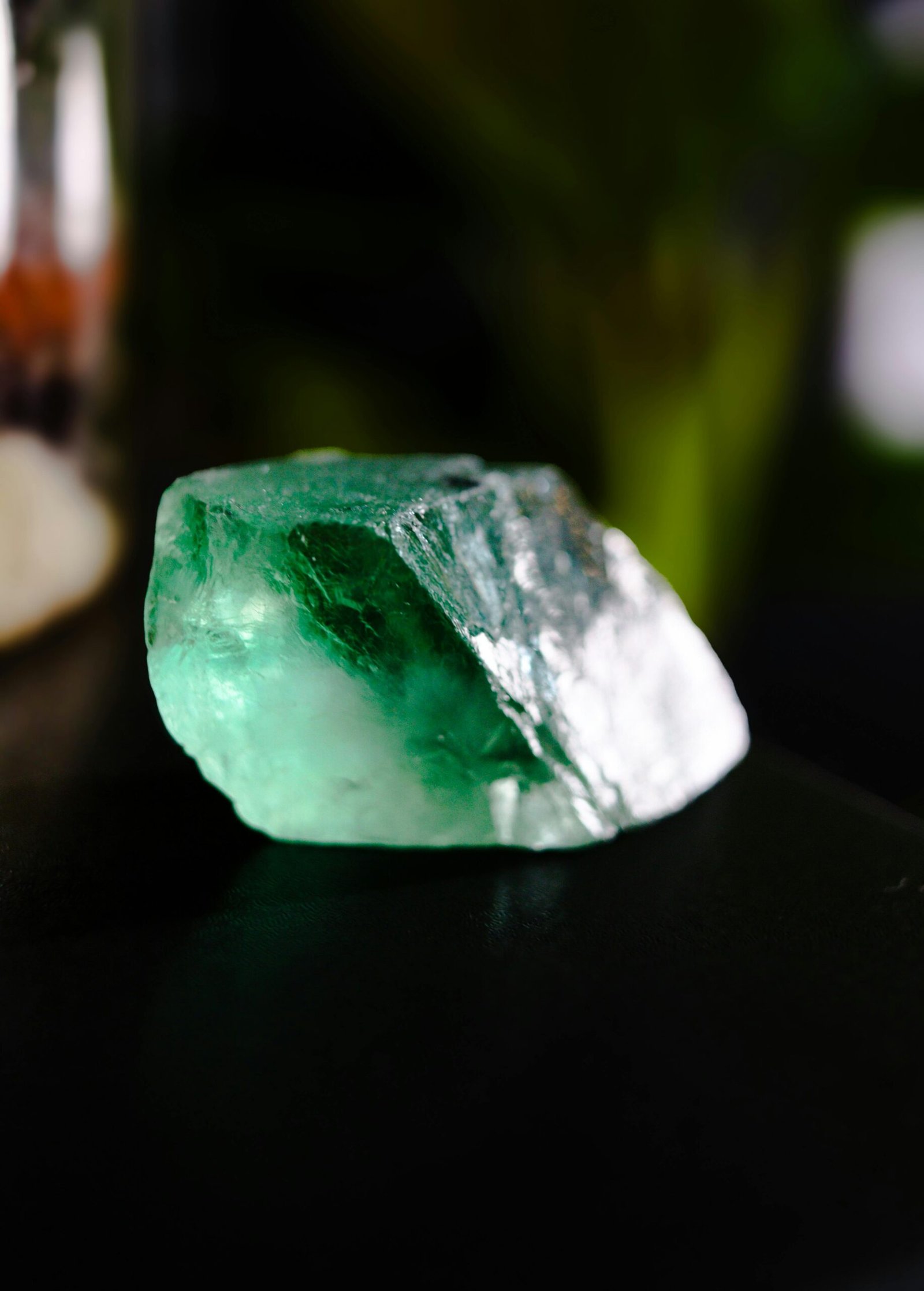
Emerald is the green variety of beryl (beryllium aluminium silicate, Be₃Al₂Si₆O₁₈) coloured by chromium, vanadium, or a combination of both. The same mineral coloured by iron alone is called green beryl — not emerald. This distinction matters commercially: chromium-coloured emeralds command significant premiums over iron-coloured green beryl of identical appearance.
Emerald is one of the four traditional precious gemstones alongside diamond, ruby, and sapphire. Despite being significantly softer than ruby or sapphire (Mohs 7.5–8 vs 9), its vivid saturated green colour has made it among the most coveted gems in history. The Aztecs prized emeralds above gold; Cleopatra’s mines in Egypt supplied the ancient world for centuries; Mughal emperors engraved their finest emeralds with inscriptions and wore them as talismans.
Emerald vs green beryl — a commercially significant distinction
Both emerald and green beryl are chemically beryl (Be₃Al₂Si₆O₁₈). The distinction is colouring agent: emerald is coloured by chromium and/or vanadium; green beryl is coloured by iron alone. Green beryl is typically lighter and less saturated than emerald. The boundary is contested — the USA recognises vanadium-coloured stones as emerald while some other standards do not. Our tool identifies both the colour saturation and the likely colouring agent, noting when a stone falls in the contested zone.
The Beryl Family — Emerald’s Gemstone Relatives
Beryl is one of the most important gemstone mineral groups, producing several distinct gem varieties distinguished by trace element colouring. Understanding the family helps you verify emerald identification and understand related stones.
The Jardin — Why Emerald Inclusions Are Different
In virtually every other gemstone, inclusions are a defect that reduces value. Emerald is the single exception where inclusions are accepted, expected, and even celebrated — they are called the jardin (French for “garden”) and are considered part of the stone’s character and fingerprint of authenticity.
Emerald forms under complex geological conditions involving highly reactive hydrothermal fluids in fractured rock. These conditions produce a characteristic spectrum of inclusions that are diagnostic of natural emerald and distinguish it from synthetic equivalents and simulants.
- Three-phase inclusions. The most diagnostic inclusion type in Colombian emeralds — cavities containing a solid crystal, a liquid, and a gas bubble simultaneously. These three-phase inclusions are extraordinarily characteristic of the Muzo and Chivor mining districts and provide near-definitive Colombian origin evidence visible under magnification.
- Two-phase inclusions. Cavities containing fluid and a gas bubble. Common in emeralds generally and less origin-specific than three-phase inclusions.
- Fingerprint inclusions. Healed fractures containing minute fluid droplets arranged in patterns resembling fingerprints. Common across multiple emerald origins.
- Tremolite needles. Fine white acicular (needle-like) crystals common in Colombian emeralds. Their presence is a positive indicator of Colombian origin.
- Pyrite crystals. Metallic golden cubic crystals sometimes present in Colombian and Zambian emeralds. Their presence confirms natural origin and in Colombian stones points specifically to the Muzo district.
- Actinolite and mica flakes. Common in emeralds from schist-hosted deposits. Their presence helps distinguish natural from synthetic and provides origin context.
“A fine Colombian emerald with a rich, vivid green colour and a visible jardin is genuinely more valuable than a synthetic of identical apparent colour and clarity. The jardin confirms natural origin — it is a record of the stone’s geological journey — and natural origin commands the premium, not perfection.”
The emerald clarity standard — different from all other gemstones
While other Type I gemstones (aquamarine, topaz, citrine) are graded to a standard of eye-clean clarity, emerald is classified as a Type III gemstone — inclusions are so common and expected that the clarity standard is entirely different. An eye-clean emerald is genuinely exceptional and commands a very significant premium. A fine emerald with a visible but not distracting jardin can be worth far more than a clean but poorly coloured stone. Colour always takes precedence over clarity in emerald valuation.
Natural, Synthetic, and Simulant Emeralds
The emerald market contains natural, synthetic, and simulant material in significant quantities at all price points. The differences in value are enormous — a fine natural Colombian emerald can be worth thousands per carat; a synthetic of identical appearance is worth a few dollars per carat.
Emerald Origins — Colombia, Zambia, and the Rest
Colombian emeralds are the gold standard of the emerald world — they command premiums of 2–5× equivalent quality stones from other origins. Our AI identifies visible origin indicators from colour character, hue, and inclusion types visible in photographs.
| Origin | Characteristic Colour | Key Visual Indicator | Market Status |
|---|---|---|---|
| Colombia (Muzo / Chivor) | Vivid bluish-green to pure green — warm, deeply saturated, exceptional chromium content | Three-phase inclusions; tremolite needles; pyrite crystals. Slightly warmer, more yellow-green from Muzo; cooler blue-green from Chivor | Ultimate Premium |
| Zambia (Kagem) | Slightly bluish-green — cooler, more blue than Colombian; excellent saturation | Typically cleaner jardin than Colombian; characteristic bluish green hue; tourmaline and actinolite inclusions common | Top Commercial |
| Brazil (Nova Era / Itabira) | Lighter green — sometimes slightly yellowish; wide colour range; vanadium coloured in some deposits | Often lighter colour than Colombian; vanadium-coloured Brazilian stones are not accepted as emerald by all labs | Good Value |
| Zimbabwe (Sandawana) | Deep, vivid green — very small crystals typically; intense chromium saturation | Very high chromium content; stones typically small (under 1ct); exceptional colour depth for size | Collectible Premium |
| Afghanistan (Panjshir) | Vivid bluish-green — fine quality comparable to Colombia in best specimens | Similar inclusion types to Colombia; limited production; increasing collector interest | Emerging Premium |
| Ethiopia | Vivid green to slightly yellowish-green; newer source with variable quality | Typically cleaner than Colombian material; relatively new source gaining market traction | Commercial |
The Colombian premium and certificate value
A laboratory certificate from GIA, Gübelin, or SSEF confirming Colombian origin — particularly from the Muzo or Chivor districts — can double or triple the value of an emerald compared to an equivalent stone without origin documentation. The premium applies specifically to fine quality material; commercial-grade Colombian emeralds do not attract the same premium. For emeralds above approximately 1 carat of fine quality, laboratory origin certification is standard practice and expected by serious buyers.
Emerald Treatments — The Most Oiled Gemstone in the World
Emerald is unique among precious gemstones in that treatment is so universal it has its own accepted scale — and untreated emeralds of any quality are among the rarest and most valuable gems available. The treatment almost always involves fracture filling to improve apparent clarity.
The Four-Level Oiling Scale
Gemological laboratories grade emerald treatment on a standardised scale. Our AI assesses visible treatment indicators from your photograph — iridescent flash in fractures, unusual clarity for the colour saturation, and surface features.
Types of Emerald Fracture Filling
- Cedar oil. The traditional treatment — natural cedar wood oil, with a refractive index close to emerald’s, is drawn into fractures under vacuum and pressure. Cedar oil yellows and dries over time, requiring periodic retreatment. Considered the most acceptable treatment because it is natural and reversible.
- Synthetic resins (Opticon, Permasafe). Synthetic resins with adjustable refractive index provide more durable, longer-lasting filling. More controversial than oil because they are harder to remove and create stronger obligations for seller disclosure. Their presence can be detected by the characteristic iridescent flash they create in fractures under oblique light.
- Epoxy resin. Hardened resin that permanently fills fractures. The most aggressive treatment — damages the stone’s natural character and is considered a significant treatment requiring full disclosure. Reduces value substantially.
- Glass filling. As with ruby, very low-grade fractured emerald material is sometimes filled with glass. This is at the extreme end of treatment — the glass constitutes significant volume of the stone and the material has minimal value as a gemstone.
Caring for oiled emeralds — critical maintenance information
Oiled and resin-filled emeralds are sensitive to heat, ultrasonic cleaning, and chemicals. Never use an ultrasonic cleaner — the vibration can drive oil out of fractures or crack already-filled material. Avoid steam cleaning. Exposure to household solvents (acetone, bleach) dissolves oil fills. Use only mild soap and lukewarm water with a soft brush. If your emerald loses its brilliance over time, it may need re-oiling — a service offered by specialist jewellers and gem laboratories.
Emerald Look-Alikes — Common Green Stone Confusions
Green is one of the most common gemstone colours, and several stones closely imitate emerald. These are the most important alternatives to know:
The birefringence test — distinguishing emerald from garnet and glass
Emerald is doubly refractive — looking through the stone with a 10× loupe, back facet edges appear slightly doubled. Garnet (singly refractive) shows no doubling. Glass (isotropic) shows no doubling. Peridot and tourmaline also show doubling but much stronger than emerald. This test, combined with the presence or absence of natural jardin inclusions, distinguishes emerald from its most common look-alikes without specialist equipment in most cases.
Frequently Asked Questions
Have an Emerald to Identify?
Upload your photo above for an instant AI assessment — or explore our full range of identifier tools below.
Identify My Emerald ↑