
Opal Identifier —
Natural, Synthetic, or Doublet?
Upload a photo of your opal — loose stone, set in jewellery, or rough — and our AI identifies the opal type, assesses play-of-colour quality, flags synthetic and composite stones, and gives you a complete expert profile in seconds. Free, no sign-up required.
What You Get in Every Result
- Opal type — Natural / Synthetic / Doublet / Triplet
- Confidence percentage with full visual reasoning
- Opal variety — Black, White/Light, Crystal, Boulder, Fire, Common
- Play-of-colour assessment — pattern, coverage, and colour range
- Body tone and transparency classification
- Geographic origin indicators — Lightning Ridge, Coober Pedy, Ethiopia, Mexico
- Composite detection — doublet and triplet indicators
- Collector value and rarity indication
- Care instructions and stability advice
Opal Identifier
Identify opal (precious/common) vs look-alikes such as glass, moonstone, lab opal, and resin composites
Drag & drop photos here
or click to browse
JPG, PNG, WEBP accepted
0 of 3 images added
Add details for better accuracy (optional)
Upload up to 3 angles for the most accurate result
Description
Origin / formation
Is Opal
Type / hint
Play-of-color
Body tone
Hydration / stability
Treatment
Synthetic
Probable origin
Hardness (Mohs)
Luster
Rarity
Relative value
Notable localities / regions
Typical colours
Key properties
Similar gemstones
Alternative identifications
Note: Opal treatments and doublet/triplet assemblies may require magnification or lab testing. Photo ID is a starting point, not an appraisal.
What Makes Opal Unique — and Why It Is So Difficult to Identify
Opal is hydrated silica (SiO₂·nH₂O) — the same element as quartz but with a critical difference: opal is amorphous rather than crystalline, meaning its silica is arranged in tiny ordered spheres rather than a repeating crystal lattice. It is these spheres — stacked in regular three-dimensional arrays — that produce opal’s most distinctive and irreproducible property: play-of-colour.
When the diameter of the silica spheres closely matches the wavelength of visible light and they are arranged in a sufficiently ordered array, light diffracts within the opal and separates into spectral colours. The colours shift and flash as the viewing angle changes. No other gemstone produces this effect through the same mechanism — which is why opal has fascinated collectors and jewellers for millennia and why the word “opal” has become synonymous with shifting, rainbow colour.
Why opal identification is uniquely challenging
Opal presents identification challenges that do not exist for crystalline gemstones. Its amorphous structure means standard refractive index testing gives a range rather than a precise reading. Its water content makes it sensitive to dehydration. Doublets and triplets — composite stones made from thin slices of real opal glued to dark backing — can be visually indistinguishable from solid natural opal except at the girdle. Synthetic opals now replicate play-of-colour convincingly. Our AI analyses the specific character of colour play, surface features, pattern geometry, and structural indicators to navigate these challenges.
Opal Varieties — From Black Opal to Fire Opal
Opal is classified by body tone, transparency, and the presence or absence of play-of-colour. Each variety has distinct visual character, geographic associations, and very different values.
Natural, Composite, and Synthetic Opals — The Critical Distinction
The opal market contains four distinct product types at very different price points, and the differences are not always immediately obvious from the top face of the stone. Understanding all four is essential before any purchase or identification.
“The most reliable way to detect an opal doublet or triplet is to examine the stone from the side — ideally immersed in water or held sideways against a dark background. A solid natural opal shows opal material throughout its full depth. A doublet shows a distinct horizontal boundary between the thin opal layer and the dark backing material. This side view is the single most important test for composite opal.”
Doublets and triplets — not inherently dishonest
Opal doublets and triplets were developed to make precious opal available at lower price points by using thin slices of quality opal over a dark backing. They are not inherently fraudulent — but they must be sold with full disclosure. A doublet priced as a solid natural opal is misrepresentation. Our AI flags visual indicators of composite construction, but examination from the girdle remains the definitive test. Always ask the seller explicitly whether an opal is solid, doublet, or triplet before purchasing.
Play-of-Colour — The Most Important Opal Quality Factor
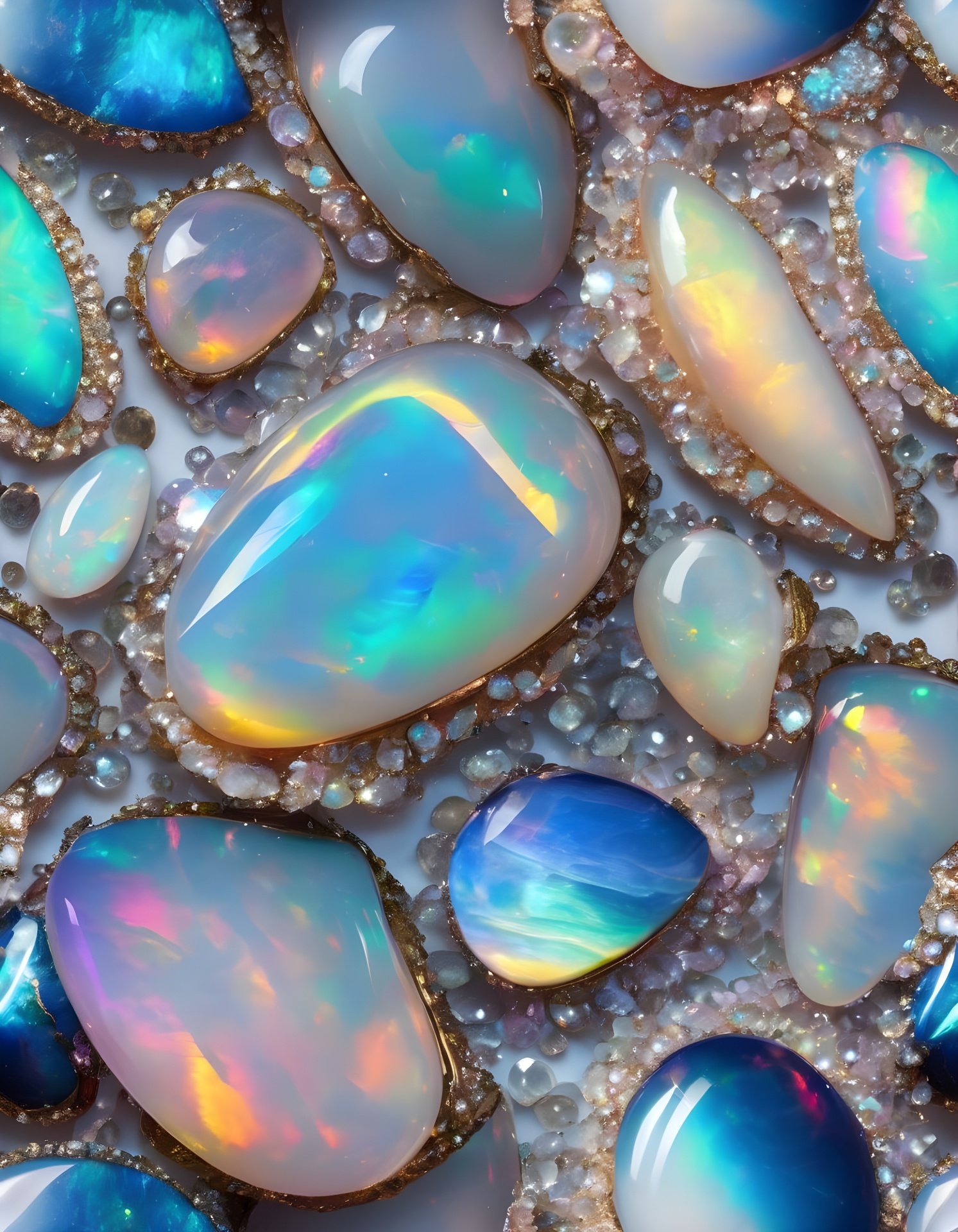
Play-of-colour is the spectacular display of spectral colours that appears to move and shift within the opal as the viewing angle changes. It is the defining characteristic of precious opal and the primary driver of value. Our AI assesses play-of-colour across four dimensions.
| Quality Factor | What It Measures | Best Grade | Value Impact |
|---|---|---|---|
| Colour Range | Which colours of the spectrum are visible. Red is the most valued — it requires the largest and most perfectly ordered silica spheres to produce | Full spectrum including red | Critical — red adds major premium |
| Brightness | Intensity and vividness of the colour display — how strongly colours flash and how visible they are in normal lighting conditions | Vivid, intense, visible in all lighting | Most Important Factor |
| Pattern | The arrangement of colour across the stone — rolling flash, harlequin, pinfire, broadflash, peacock, etc. Pattern affects both aesthetics and value | Harlequin (mosaic squares) — rarest pattern | High Impact |
| Coverage | Percentage of the stone surface showing play-of-colour. Stones with colour across the entire face are preferred to those with patches or windows | 100% coverage across full face | Significant Impact |
| Directionality | Whether colour shows from multiple viewing angles or only from one specific direction (windowed or directional opals are less valued) | Omnidirectional — visible from all angles | Moderate Impact |
| Colour Shifting | How dramatically the colours change as the stone moves — the rolling, living quality of the colour display that makes opal so mesmerising | Strong shift with pronounced movement | Aesthetic Value |
The Most Valued Opal Colour Patterns
- Harlequin. The rarest and most prized pattern — large, equally-sized, angular patches of colour arranged like a mosaic or chessboard covering the entire stone face. True harlequin pattern with even, well-defined squares is extremely rare and commands exceptional premiums. Many stones described as harlequin are actually broad flash with irregular patches.
- Broadflash. Large, broad sweeps of single colour that roll across the stone with movement. Strong broadflash covering the full face is highly desirable and commands strong premiums. More common than harlequin but still relatively rare.
- Rolling flash. A vivid wave of colour that appears to roll across the stone as it moves. The dynamic, living quality of rolling flash is visually striking and much loved by collectors.
- Peacock. A combination of blue and green colours resembling the iridescent tail of a peacock. A classic and desirable pattern — particularly prized in black opal where the dark body tone intensifies the blue-green display.
- Pinfire. Tiny dots of colour — like confetti — scattered across the stone face. Each dot is a small cluster of ordered silica spheres. While less dramatic than broadflash, fine pinfire with red dots on a black background is a classic and desirable pattern.
Where Opal Comes From — Major Sources and Their Character
Australia produces approximately 95% of the world’s precious opal, but new sources in Ethiopia and other countries have significantly expanded supply in recent years. Our AI identifies visible origin indicators from colour character, pattern type, and body tone.
Opal Care — Protecting the Most Delicate Precious Gemstone
Opal requires more careful handling than any other precious gemstone. Its combination of water content, relatively low hardness (Mohs 5.5–6.5), and amorphous structure makes it sensitive to several environmental factors that other gems tolerate easily.
Frequently Asked Questions
Have an Opal to Identify?
Upload your photo above for an instant AI assessment — or explore our full range of identifier tools below.
Identify My Opal ↑