
Fluorite Identifier —
Natural, Dyed, or Look-Alike?
Upload a photo of your fluorite — crystal, tumbled stone, carving, or jewellery — and our AI identifies the variety, assesses colour zoning, detects UV fluorescence indicators, distinguishes fluorite from amethyst and glass, and gives you a complete expert result in seconds. Free, no sign-up required.
What You Get in Every Result
- Fluorite verdict — Natural / Dyed / Simulant
- Confidence percentage with full visual reasoning
- Colour variety — Purple, Green, Blue, Yellow, Rainbow, Blue John, Yttrofluorite
- Colour zoning assessment — octahedral or banded patterns
- UV fluorescence indicator — the mineral that named the phenomenon
- Cleavage pattern assessment — perfect octahedral cleavage indicator
- Geographic origin indicators — China, UK, USA, Mexico, Namibia
- Collector value and care/fragility advice
Fluorite Identifier
Identify fluorite (often purple/green, cubic crystals) vs common look-alikes like calcite, quartz, glass, and amethyst
Drag & drop photos here
or click to browse
JPG, PNG, WEBP accepted
0 of 3 images added
Add details for better accuracy (optional)
Upload up to 3 angles for the most accurate result
Description
Origin / formation
Is Fluorite
Variety
Crystal habit
Cleavage / fracture
Color zoning
Fluorescence
Hardness
Probable origin
Hardness (Mohs)
Luster
Rarity
Relative value
Notable localities / regions
Typical colours
Key properties
Similar minerals
Alternative identifications
Note: Fluorite can be confused with quartz/amethyst and calcite. Hardness and cleavage checks help; photo ID is a starting point, not an appraisal.
What Is Fluorite — The Mineral That Named Fluorescence
Fluorite is calcium fluoride (CaF₂) — one of the most visually spectacular and scientifically important minerals in the world. It forms beautiful cubic crystals in an extraordinary range of colours and is the mineral that gave its name to the phenomenon of fluorescence: many specimens glow vivid blue, green, or other colours under ultraviolet light, and the word “fluorescence” is derived directly from “fluorite.”
Fluorite forms in hydrothermal veins — hot mineral-rich fluids moving through rock fractures — where it crystallises alongside calcite, quartz, barite, and metallic ore minerals. It is exceptionally common globally and produced in enormous quantities as an industrial mineral (used in steel production, aluminium smelting, and fluoride chemistry), but gem-quality fluorite with exceptional colour, clarity, and crystal form is a coveted collector mineral commanding significant prices at shows and auctions.
Fluorite and fluorescence — the mineral that named a phenomenon
In 1852, physicist George Gabriel Stokes observed that certain minerals emitted light of a longer wavelength than the light illuminating them — they absorbed ultraviolet and re-emitted visible light. He named this phenomenon “fluorescence” after fluorite, which was one of the most dramatic examples he studied. The glowing blue that many fluorite specimens display under shortwave UV light is caused by trace impurities — particularly yttrium and other rare earth elements — that activate the fluorescence. Not all fluorite fluoresces; the presence and colour of fluorescence are diagnostic for specific localities.
Fluorite’s Colour Spectrum — The Most Colourful Mineral
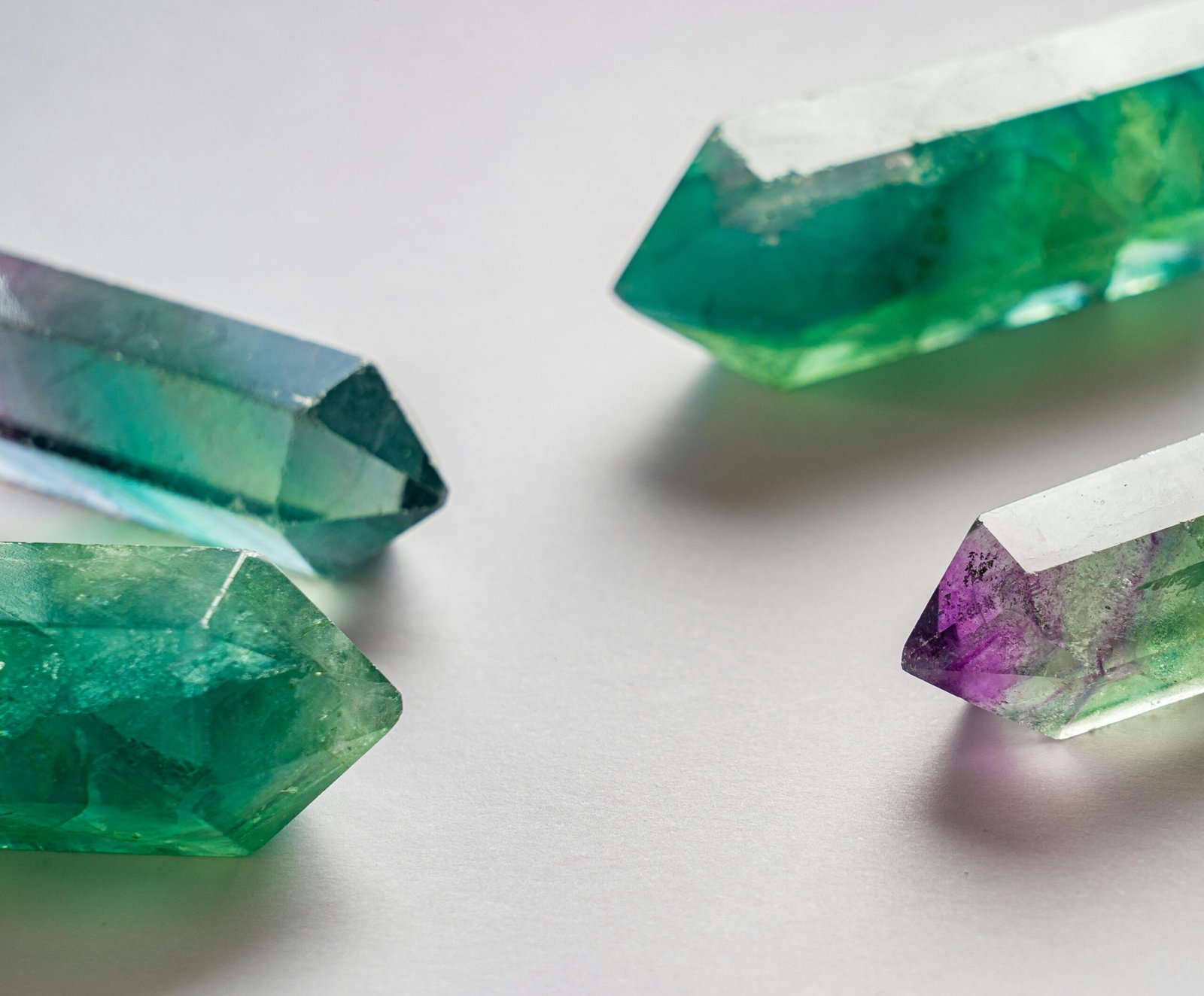
Fluorite is sometimes called “the most colourful mineral in the world” — it occurs in virtually every colour, and many specimens show multiple colours simultaneously in bands, zones, or patches. Our AI identifies all major fluorite colour varieties:
Fluorite’s Fluorescence — The UV Glow
Fluorite is one of the most dramatically fluorescent minerals in the world, and UV fluorescence is a key diagnostic tool for identifying both the mineral and specific geographic localities. The fluorescence colour and intensity vary between deposits — making it a useful origin indicator.
“Hold a strong UV torch to a piece of fluorite from the right locality — Cave-in-Rock, Illinois or Rogerley Mine, Durham — and watch it transform. What looks like a pale, almost transparent mineral in ordinary light ignites into a vivid electric blue glow that seems to come from within the crystal itself. This is why George Stokes named the phenomenon after fluorite: no other mineral demonstrates it quite so dramatically.”
Why not all fluorite fluoresces — locality-specific fluorescence
Fluorescence in fluorite is caused by trace activators — primarily rare earth elements like yttrium, europium, and dysprosium — and quenchers that suppress it. Different deposits have different trace element chemistries, so fluorescence varies dramatically by locality. Fluorite from Cave-in-Rock, Illinois fluoresces vivid blue under shortwave UV — almost every specimen. Fluorite from Dalnegorsk, Russia often does not fluoresce at all. This locality-specific fluorescence behaviour is a useful origin indicator. Our AI notes where fluorescence is expected based on visible characteristics, but UV testing with an actual UV torch provides definitive information.
Blue John Fluorite — England’s Most Famous Mineral
Blue John — The Most Collectible Fluorite on Earth
Blue John is a unique variety of fluorite found exclusively in the Blue John Cavern and Treak Cliff Cavern in the Peak District of Derbyshire, England. Its characteristic purple, yellow, and white banded pattern — which actually appears more purple-white than truly blue — is found nowhere else on Earth. The name “Blue John” possibly derives from the French bleu-jaune (blue-yellow) or from a miner’s description of its appearance.
The quantity of Blue John mined each year is strictly limited — approximately 500 kg of raw material per year — which, combined with the complex cutting and vase-turning required to work the fragile banded material, makes finished Blue John objects genuinely scarce. The caverns have been mined for over 300 years; the distinctive banded pattern is unlike any other fluorite locality in the world.
Blue John has been carved into vases, bowls, jewellery, and decorative objects since the 18th century. Matthew Boulton — partner of James Watt and the great Birmingham manufacturer — promoted Blue John objects extensively. Fine antique Blue John vases with ormolu (gilt bronze) mounts by Boulton are now extremely valuable. Contemporary Blue John jewellery and objects are made in small quantities from Derbyshire workshops and command significant premiums over equivalent fluorite from other sources.
Fluorite’s Perfect Octahedral Cleavage — Its Most Distinctive Property
Fluorite has perfect cleavage in four directions — forming the faces of an octahedron. This means that when struck sharply, fluorite cleaves into perfect octahedral fragments with flat, triangular faces. This property is both diagnostically useful for identification and a significant practical limitation for jewellery use.
- Identification use. The presence of flat, triangular cleavage faces on chips or breaks from a specimen immediately confirms fluorite — no other common mineral cleaves in exactly this way. A broken fluorite specimen shows perfectly flat, reflective triangular faces rather than the curved conchoidal fracture of quartz or the irregular fracture of calcite.
- Why fluorite is soft and fragile. Fluorite is Mohs 4 — significantly softer than quartz (7), feldspar (6–6.5), and most gemstones used in jewellery. It scratches easily. Combined with perfect octahedral cleavage, this makes fluorite fundamentally unsuited to ring wear — the combination of scratching and shock cleavage will damage a fluorite ring stone quickly in normal use.
- Faceted fluorite paradox. Despite its fragility, faceted fluorite is popular in collector gemstone circles because it can be extraordinarily beautiful — its high transparency, attractive colours, and relatively high refractive index (1.434) produce attractive faceted gems. The paradox is that fluorite’s very softness and cleavage make it impractical for most jewellery — it is most safely worn in pendants and earrings where impact risk is minimal.
- Industrial importance. Fluorite’s importance as an industrial mineral far exceeds its gemological significance. It is used as a flux in steel and aluminium production, as a source of fluorine for the chemical industry (Teflon, refrigerants, pharmaceuticals), and in optical manufacturing — high-purity fluorite is used in apochromatic camera lenses and microscope objectives because it disperses light with less chromatic aberration than glass.
Fluorite and heat — thermoluminescence and fading
Some fluorite colours are photosensitive or thermoluminescent — they glow when heated and can fade in prolonged strong sunlight. Purple fluorite in particular can lose colour saturation over extended periods of UV exposure. This is not a concern for crystal specimens kept indoors in normal display conditions, but collectors should avoid displaying fluorite in direct, sustained sunlight. The thermoluminescent property — a faint glow when the crystal is warmed — is a curious characteristic used in some geological dating applications but has no practical impact on normal handling.
Fluorite Origins — Worldwide but Locally Distinctive
Fluorite is one of the most globally widespread minerals — significant deposits exist on every continent. However, certain localities have produced extraordinary material that has defined collector standards for specific colours and crystal habits.
| Origin | Characteristic Variety | Key Feature | Collector Status |
|---|---|---|---|
| Derbyshire, UK (Blue John) | Purple-white-yellow banded | Blue John — found nowhere else on Earth. Banded purple-white-yellow pattern. Strictly limited annual production. England’s most collectible mineral | Unique — irreplaceable |
| Rogerley Mine, Durham, UK | Vivid green colour-change | Produces vivid green fluorite with a dramatic colour shift between fluorescent and incandescent light — highly sought by collectors worldwide. Limited production | Premier collector quality |
| Cave-in-Rock, Illinois, USA | Blue, purple, yellow — all with vivid UV fluorescence | Historic Illinois mining district. Produces strongly UV-fluorescent specimens. Illinois Blue fluorite is iconic in the collector world. Many museum-quality specimens exist | Iconic collector locality |
| Hunan Province, China | Green, purple, pink — large crystals | Dominant source of commercial fluorite specimens globally. Produces exceptional green, purple, and pink crystals of large size. Reliable quality at accessible prices | Premium commercial source |
| Namibia (Erongo, Okorusu) | Green, blue — on matrix | Produces fine green and blue fluorite, often with associated minerals on matrix. Erongo green fluorite with aquamarine is particularly prized | Collector — fine matrix pieces |
| Zacatecas, Mexico | Purple, green, rainbow — transparent | Produces very transparent multi-colour fluorite. Good source for faceted material and collector octahedra. Commercial quantities at good quality | Good Commercial |
| Dalnegorsk, Russia | Green, white, purple — on quartz | Produces beautiful fluorite on quartz matrix. Often non-fluorescent under UV — locality diagnostic. Classic collector specimens from the famous polymetallic deposit | Collector — matrix specimens |
Fluorite Look-Alikes — The Most Common Confusions
Fluorite’s wide colour range means it can resemble many other minerals — and conversely, several minerals are sometimes sold as fluorite. The key distinguishing property for most confusions is hardness: fluorite (Mohs 4) is dramatically softer than quartz-group minerals (Mohs 7), which eliminates the most common confusions immediately.
The hardness test — fastest field test for fluorite
The quickest and most reliable field test for fluorite vs quartz-family minerals is hardness. A piece of quartz (which you can find in most gravel), a steel knife blade (Mohs 5.5), or a copper coin (Mohs 3.5) tests fluorite’s hardness (Mohs 4) immediately. Fluorite is scratched by a steel knife blade; amethyst, citrine, and other quartz minerals are not. If your purple crystal scratches easily with a steel blade, it is almost certainly fluorite or calcite. If the steel slides off without marking, it is quartz-family. This test takes 10 seconds and eliminates the most common confusion.
Frequently Asked Questions
Have Fluorite to Identify?
Upload your photo above for an instant AI assessment — or explore our full range of identifier tools below.
Identify My Fluorite ↑