
Selenite Identifier —
Which Gypsum Variety Is This?
Upload a photo of your selenite, satin spar, desert rose, or gypsum specimen and our AI identifies the exact gypsum variety, distinguishes it from calcite and quartz, assesses transparency and fibre quality, and gives you a complete expert result in seconds. Free, no sign-up required.
What You Get in Every Result
- Gypsum variety — Selenite, Satin Spar, Desert Rose, Alabaster, Gypsite
- Confidence percentage with full visual reasoning
- Transparency and optical clarity assessment
- Fibre quality for satin spar — chatoyancy strength
- Distinction from calcite, quartz, and white minerals
- Geographic origin indicators — Mexico, Morocco, USA, UK, Australia
- Crystal Cave of Giants context (Naica Mine, Mexico)
- Care warnings — fragility, water sensitivity, scratching
Selenite Identifier
Identify selenite (gypsum) vs calcite, quartz, halite, and man-made look-alikes
Drag & drop photos here
or click to browse
JPG, PNG, WEBP accepted
0 of 3 images added
Add details for better accuracy (optional)
Upload up to 3 angles for the most accurate result
Description
Origin / formation
Is Selenite (gypsum)
Gypsum variety hint
Softness test
Habit / texture
vs look-alikes
Water sensitivity
Hardness (Mohs)
Luster
Rarity
Relative value
Notable localities / regions
Typical colours
Key properties
Similar minerals
Alternative identifications
Note: The most reliable check for selenite/gypsum is softness (scratches with a fingernail). Quartz/glass will not. Avoid soaking; gypsum can etch/dissolve. Photo ID is a starting point, not an appraisal.
What Is Selenite — and Why “Selenite” Is Just One Gypsum Variety
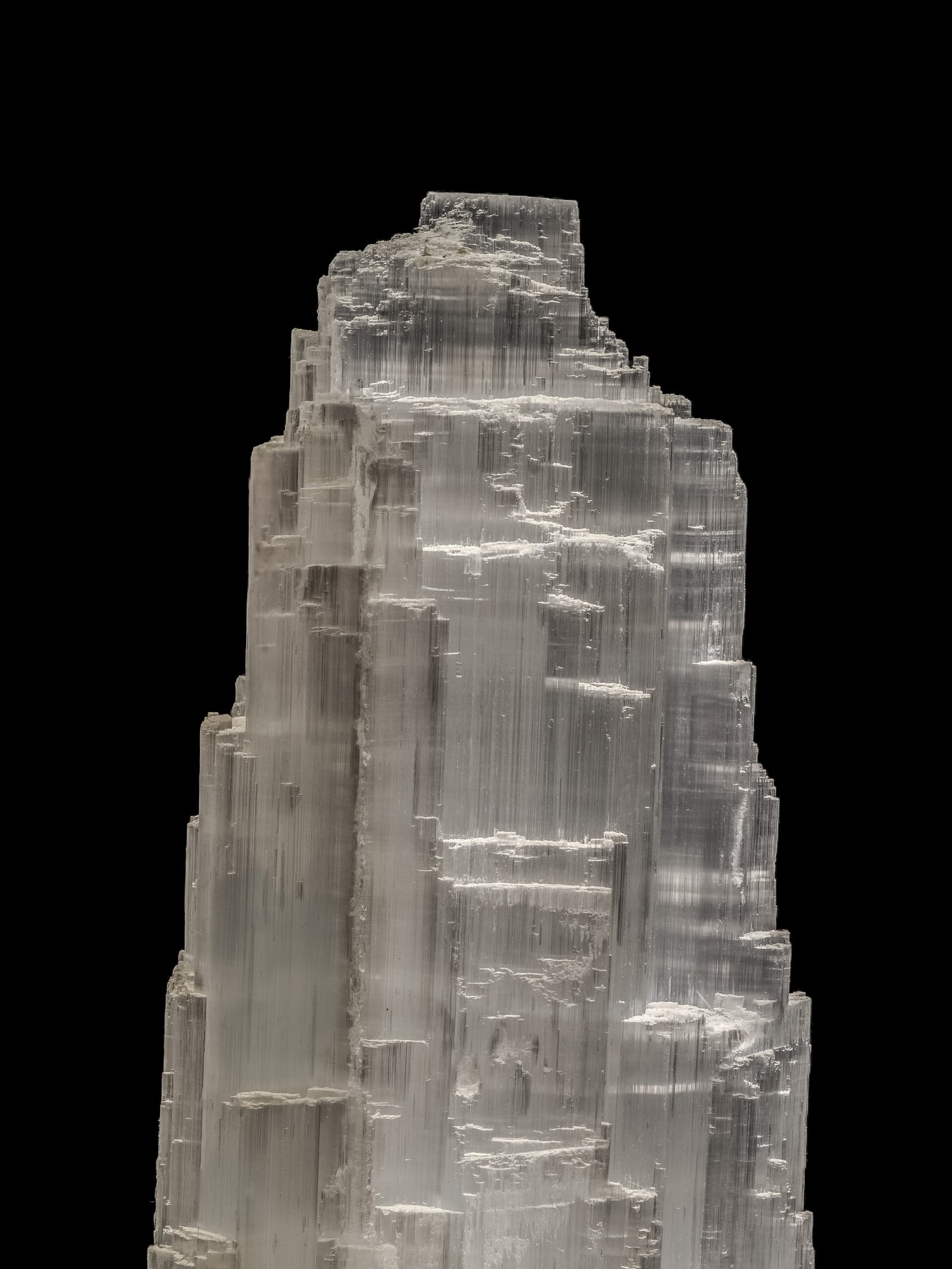
Selenite is a specific variety of gypsum — the mineral calcium sulphate dihydrate (CaSO₄·2H₂O) — not a separate mineral. The name “selenite” specifically refers to clear, transparent or translucent gypsum with a vitreous to pearly luster, typically forming large plate-like or bladed crystals. It is named from the Greek selene (moon) for its moon-like pearly glow.
In the crystal healing and metaphysical market, “selenite” is used loosely to refer to any white or pale gypsum material — including satin spar, alabaster, and desert rose — which are all gypsum varieties but are mineralogically distinct from true selenite. Understanding which gypsum variety you actually have is important for care and handling, as each has slightly different properties and ideal uses.
All gypsum varieties share the same fundamental properties: they are among the softest common minerals (Mohs 2 — scratched by a fingernail), they are sensitive to water (gypsum slowly dissolves in prolonged contact with water), and they should never be cleaned in ultrasonic or steam cleaners. These care requirements apply across all varieties.
Mohs 2 — the softest common mineral in jewellery and crystal markets
Gypsum (including selenite, satin spar, and alabaster) is Mohs 2 — meaning it is scratched by a fingernail (Mohs 2.5) and easily scratched by a copper coin (Mohs 3.5), steel knife (Mohs 5.5), or virtually any other hard object. This extraordinary softness is the single most important practical property of selenite: it scratches from dust, storage contact with other materials, and even rough handling. It is not suitable for everyday jewellery wear and requires careful storage and handling to maintain its polish.
Gypsum Varieties — Selenite, Satin Spar, Desert Rose, and Alabaster
All of the following are gypsum — the same mineral (CaSO₄·2H₂O) — but each forms under different conditions and has a distinct appearance, texture, and set of properties. Our AI identifies which gypsum variety you have.
The Cave of Crystals — Naica Mine, Mexico
In the year 2000, miners in the Naica silver and lead mine in Chihuahua, Mexico, broke through a wall into a chamber that was unlike anything seen before in mineralogy. The Cave of Crystals (Cueva de los Cristales) contained selenite crystals of absolutely staggering scale — the largest reaching 11 metres in length and weighing approximately 55 tonnes. These are the largest natural crystals ever found on Earth.
The crystals grew over an estimated 500,000 years in water that was supersaturated with calcium sulphate at a constant temperature of approximately 58°C — just below the temperature at which gypsum converts to anhydrite. The cave remained sealed from the surface and maintained at this precise temperature, allowing the crystals to grow continuously without interruption.
The cave is essentially inaccessible to humans for extended periods without protective suits — the heat and humidity (the air is saturated with water vapour at 58°C) would cause fatal hyperthermia within minutes. Scientists could only enter with ice-packed cooling suits. When the mine pumping operations ceased and the cave reflooded with groundwater, the crystals resumed their growth. The Naica crystals represent the ultimate expression of what selenite can become given unlimited time and ideal conditions.
“Every piece of selenite you hold — whether a small tumbled wand from a crystal shop or a large tower from Morocco — is made of the same mineral as the giants of Naica. The difference is time, temperature, and the extraordinary patience of geological processes. A wand of satin spar from Morocco may have grown in thousands of years; the Naica crystals grew for half a million.”
Gypsum Varieties — Quick Reference Comparison
All varieties below are the same mineral — CaSO₄·2H₂O — sharing Mohs 2 hardness, sensitivity to water, and perfect cleavage. The differences are in crystal habit, texture, and formation environment.
| Variety | Crystal Habit | Visual Character | Primary Use | Key Identifier |
|---|---|---|---|---|
| Selenite | Large tabular, bladed, or prismatic crystals | Clear to translucent, vitreous to pearly luster, flat cleavage faces | Crystal wands, towers, lamps, specimens | Transparency, flat cleavage faces, large crystal form |
| Satin Spar | Fibrous, parallel-fibre masses | White to cream, silky-satiny sheen, chatoyancy, rolls of light across surface | Wands, towers, bowls, cabochons | Silky chatoyant sheen, fibrous texture, rolling cat’s eye effect |
| Desert Rose | Sand-included rosette aggregates | Tan to reddish-brown, petal-like clusters, granular texture from sand | Decorative specimens, collectors | Rose-like petal form, sand inclusions, sandy colour |
| Alabaster | Massive, fine-grained, no visible crystals | White to cream, smooth waxy-vitreous surface, homogeneous | Sculpture, carving, ornamental objects | No crystal structure visible, smooth uniform surface |
| Gypsum Rosette / Star | Radiating bladed aggregates, disc or star form | Translucent, disc-shaped or star-shaped, flat blades | Specimens, collectors | Radiating disc form, translucent blades |
| Gypsite | Earthy, powdery or granular masses | White to yellowish-white, chalky appearance, earthy luster | Agricultural (soil amendment), industrial | Earthy powdery texture, very soft, chalky |
What most crystal shops sell as “selenite” is actually satin spar
The vast majority of “selenite” wands, towers, bowls, and spheres sold in crystal shops worldwide are technically satin spar — the fibrous chatoyant gypsum with the characteristic silky sheen — not true selenite (the transparent or translucent crystalline variety). Both are gypsum and both have the same hardness and care requirements. The distinction is primarily important for collectors who want to be precise about variety terminology. In everyday use, the name “selenite” has become the accepted commercial term for both varieties, and no deception is intended in its use — it is simply a trade convention.
Selenite Look-Alikes — White and Transparent Mineral Confusions
Several white or transparent minerals can be confused with selenite or satin spar, particularly in the crystal healing market. The extremely low hardness of all gypsum varieties (Mohs 2) is the most immediate distinguishing property:
The fingernail test — the universal gypsum field identifier
The single fastest, most reliable, and most accessible test for selenite and all gypsum varieties is the fingernail scratch test. Gypsum is Mohs 2 — softer than a human fingernail (Mohs 2.5). This means you can scratch gypsum with your fingernail. No other common mineral used in the crystal market is this soft except talc. If a stone claiming to be selenite cannot be scratched by your fingernail, it is not gypsum — it is calcite, quartz, or another harder mineral. This test takes seconds and eliminates every common gypsum look-alike immediately.
Selenite and Water — Why the Crystal Healing “Water Cleansing” Advice Is Wrong
A pervasive piece of advice in crystal healing communities is to cleanse selenite in water or salt water. This advice is mineralogically incorrect and will damage your stone:
- Gypsum dissolves in water. Gypsum (CaSO₄·2H₂O) is slightly but measurably soluble in water. The dissolution rate is slow — you cannot watch it happen in real time — but prolonged contact with water will gradually dissolve and etch the polished surface of selenite and satin spar. The first sign is a loss of surface polish and development of a slightly frosted, rough surface. This damage is irreversible.
- Salt water accelerates damage. Salt (sodium chloride) dissolved in water dramatically accelerates the dissolution and chemical alteration of gypsum surfaces. Salt water “cleansing” causes faster and more severe surface deterioration than plain water. Never soak selenite in salt water under any circumstances.
- Surface moisture is less harmful than immersion. A light wipe with a barely damp cloth is substantially less damaging than prolonged water contact. If you need to clean dust from selenite, use a dry soft cloth or very lightly dampened cloth and dry immediately. Never immerse in water.
- Better alternatives for energetic cleansing. If you use selenite for metaphysical purposes, safer physical care involves: placing in moonlight or sunlight, using sound (singing bowls, bells), using smoke (incense), or simply placing near other cleansing crystals. None of these methods involve water contact.
⚠ Never put selenite in water — this will damage it permanently
This bears repeating because the misinformation is widespread: selenite and all gypsum varieties will be damaged by prolonged water contact. The surface becomes dull, frosted, and rough as the material slowly dissolves. This damage cannot be reversed without repolishing (which removes material from the stone). Short accidental water contact — a splash, brief rain exposure — is unlikely to cause visible damage. But soaking, immersing, or placing in water for crystal cleansing rituals will progressively destroy the polish and surface quality of your selenite.
Selenite Care — Protecting the World’s Most Delicate Common Crystal
Selenite and all gypsum varieties require more careful handling than almost any other stone sold in the crystal market. Here is the complete care guide:
- Storage. Store selenite separately from all other crystals and stones. Because it is Mohs 2, literally any other crystal or hard object will scratch it — quartz (7), calcite (3), even a copper coin (3.5). A padded individual pouch, lined box, or soft cloth wrapping prevents surface damage in storage.
- Cleaning. Dust with a very soft dry brush (a soft makeup brush or camera lens brush works well) or wipe gently with a dry soft cloth. If moisture is absolutely needed, use a barely damp cloth and dry immediately. No soaking, no washing, no ultrasonic, no steam.
- Display. Keep away from humid environments — a bathroom shelf, near a kitchen sink, or in a basement are poor display locations for gypsum. Moderate indoor humidity is fine; sustained high humidity accelerates surface dissolution.
- Jewellery. Selenite and satin spar are not suitable for everyday jewellery wear. They are too soft to survive daily contact with hard surfaces and will scratch extensively within days. Occasional decorative use (a pendant worn rarely for special occasions) is possible with care, but any regular wear will quickly damage the stone.
- Handling. Handle selenite with clean, dry hands. Oils and moisture from skin contact accelerate surface dulling over time. The natural oils in fingerprints can slowly etch polished surfaces.
Frequently Asked Questions
Have Selenite to Identify?
Upload your photo above for an instant AI assessment — or explore our full range of identifier tools below.
Identify My Selenite ↑