
Mineral Identifier —
What Mineral Is This?
Upload a photo of any mineral specimen — ore, native element, crystal, massive form, or rough rock — and our AI identifies the mineral species, crystal system, key properties, and practical uses in seconds. Free, no sign-up, works on any device.
What You Get in Every Result
- Mineral name, chemical formula, and mineral group
- Confidence percentage with detailed visual reasoning
- Crystal system, habit, and cleavage description
- Mohs hardness, luster type, and specific gravity
- Geological formation environment and host rock type
- Industrial uses and economic importance
- Global locations where this mineral is commonly found
- Similar minerals and how to distinguish them
- Rarity, collector value, and care advice
Mineral Identifier
Upload photos of a mineral, crystal, or ore — get an AI-powered identification with properties, locality hints, and collector tips.
Drag & drop photos here
or click to browse
JPG, PNG, WEBP accepted
0 of 3 images added
Add details for better accuracy (optional)
Upload up to 3 angles for the most accurate result
Description
Origin / formation
Hardness (Mohs)
Luster
Rarity
Relative value
Notable localities / regions
Typical colours
Key properties
Similar minerals
Alternative identifications
What Is Mineral Identification?
Mineral identification is the systematic process of determining a mineral’s exact species by examining its physical and chemical properties. Mineralogists use a defined set of diagnostic tests — hardness, streak, luster, cleavage, crystal form, and specific gravity — to narrow thousands of possible species down to a single, definitive identification.
Our AI replicates this process from photographs. When you upload an image, the model simultaneously analyses every visible diagnostic property and cross-references them against a comprehensive mineralogical database covering all major mineral groups. The result is not just a name — it is a complete mineral profile with the reasoning that led to the identification, a confidence score, and the alternative minerals worth ruling out.
How many minerals exist?
The International Mineralogical Association currently recognises over 5,900 valid mineral species. Of these, roughly 150 are commonly encountered by collectors, geologists, and prospectors. Our AI covers all commonly encountered species with high accuracy, and extends to rare and unusual minerals at lower confidence levels where visual identification becomes inherently uncertain.
The Eight Major Mineral Groups
Mineralogists classify all minerals into eight chemical groups based on their dominant anion or anionic complex. Understanding which group your mineral belongs to is often the fastest route to a correct identification, because physical properties cluster strongly within groups.
The Seven Key Properties Used in Mineral Identification
Professional mineralogists use a systematic set of physical tests to identify minerals. Our AI analyses these same properties from your photographs — and where a property cannot be determined visually, it tells you exactly what physical test to perform to confirm the identification.
“The key to mineral identification is using multiple properties together — never just one. A mineral that is green, soft, and effervesces in acid is almost certainly malachite. A mineral that is green, hard, and vitreous is almost certainly a silicate. The combination is always more powerful than any single observation.”
Common Minerals — Quick Identification Reference
These are the minerals most frequently encountered by field collectors, geology students, and rockhounds. Knowing their key diagnostic properties helps you understand and verify the AI’s identification reasoning.
| Mineral | Group | Hardness | Luster | Key Diagnostic Property |
|---|---|---|---|---|
| Quartz | Silicate | 7 Mohs | Vitreous | Hexagonal prisms with pyramidal termination; conchoidal fracture; no cleavage |
| Calcite | Carbonate | 3 Mohs | Vitreous to pearly | Perfect rhombohedral cleavage in 3 directions; effervesces strongly in dilute acid |
| Pyrite | Sulfide | 6–6.5 Mohs | Metallic | Brassy cubic crystals with striated faces; black streak; brittle |
| Feldspar (Orthoclase) | Silicate | 6 Mohs | Vitreous to pearly | Two perfect cleavages at 90°; pink, white or grey; most abundant mineral in crust |
| Mica (Muscovite) | Silicate | 2–3 Mohs | Pearly to vitreous | Perfect basal cleavage producing flexible elastic sheets; silver to gold colour |
| Hematite | Oxide | 5–6 Mohs | Metallic to earthy | Red-brown streak regardless of surface colour; common botryoidal and specular habits |
| Magnetite | Oxide | 5.5–6.5 Mohs | Metallic | Strongly magnetic; black octahedral crystals or massive; black streak |
| Galena | Sulfide | 2.5 Mohs | Bright metallic | Perfect cubic cleavage; lead-grey colour; extremely heavy (SG 7.6); grey streak |
| Fluorite | Halide | 4 Mohs | Vitreous | Perfect octahedral cleavage; cubic crystals; wide colour range; UV fluorescence |
| Gypsum / Selenite | Sulfate | 2 Mohs | Vitreous to silky | Can be scratched with a fingernail; perfect cleavage; transparent bladed crystals |
| Malachite | Carbonate | 3.5–4 Mohs | Vitreous to silky | Always green; distinctive banded botryoidal habit; effervesces in acid |
| Apatite | Phosphate | 5 Mohs | Vitreous to resinous | Hexagonal prisms; hardness 5 is diagnostic (scratches glass, scratched by knife) |
Industrial Minerals — Why Identification Matters Beyond Collecting
Minerals are not just objects of beauty for collectors — they are the raw materials of modern civilisation. Correctly identifying a mineral specimen can tell you whether you are looking at an economically significant ore, an industrial raw material, or a gangue mineral with no commercial value.
- Ore minerals are those from which metals are economically extracted. Chalcopyrite and bornite are the primary ores of copper. Galena is the primary ore of lead and silver. Sphalerite is the primary ore of zinc. Cassiterite is the ore of tin. Recognising these in hand specimens is a fundamental field geology skill.
- Industrial non-metallic minerals include gypsum (plaster, cement, wallboard), calcite (cement, lime, paper filler), talc (cosmetics, ceramics, paper), barite (drilling mud, paint, barium compounds), and fluorite (aluminium smelting, hydrofluoric acid production). These lack the glamour of gem minerals but drive enormous industries.
- Critical minerals — lithium (spodumene, lepidolite), cobalt (cobaltite, smaltite), rare earth minerals (monazite, bastnäsite) — are increasingly important for battery technology and electronics. Being able to recognise these in the field has become a high-value geological skill.
- Gangue minerals are those that occur alongside ore minerals but have no economic value themselves — quartz, calcite, and barite frequently appear as gangue. Identifying them correctly helps geologists understand the mineralising fluids and temperatures that created an ore deposit.
Safety note for certain minerals
Some minerals require careful handling. Asbestos minerals (chrysotile, crocidolite, amosite) release hazardous fibres when handled without protection. Arsenopyrite and realgar contain arsenic. Uraninite and thorite are weakly radioactive. Cinnabar contains mercury. Our identification results include handling safety notes for any mineral with known hazards.
How to Photograph Minerals for Best Identification Results
Mineral specimens present specific photographic challenges. These tips apply across all mineral types and consistently improve identification accuracy:
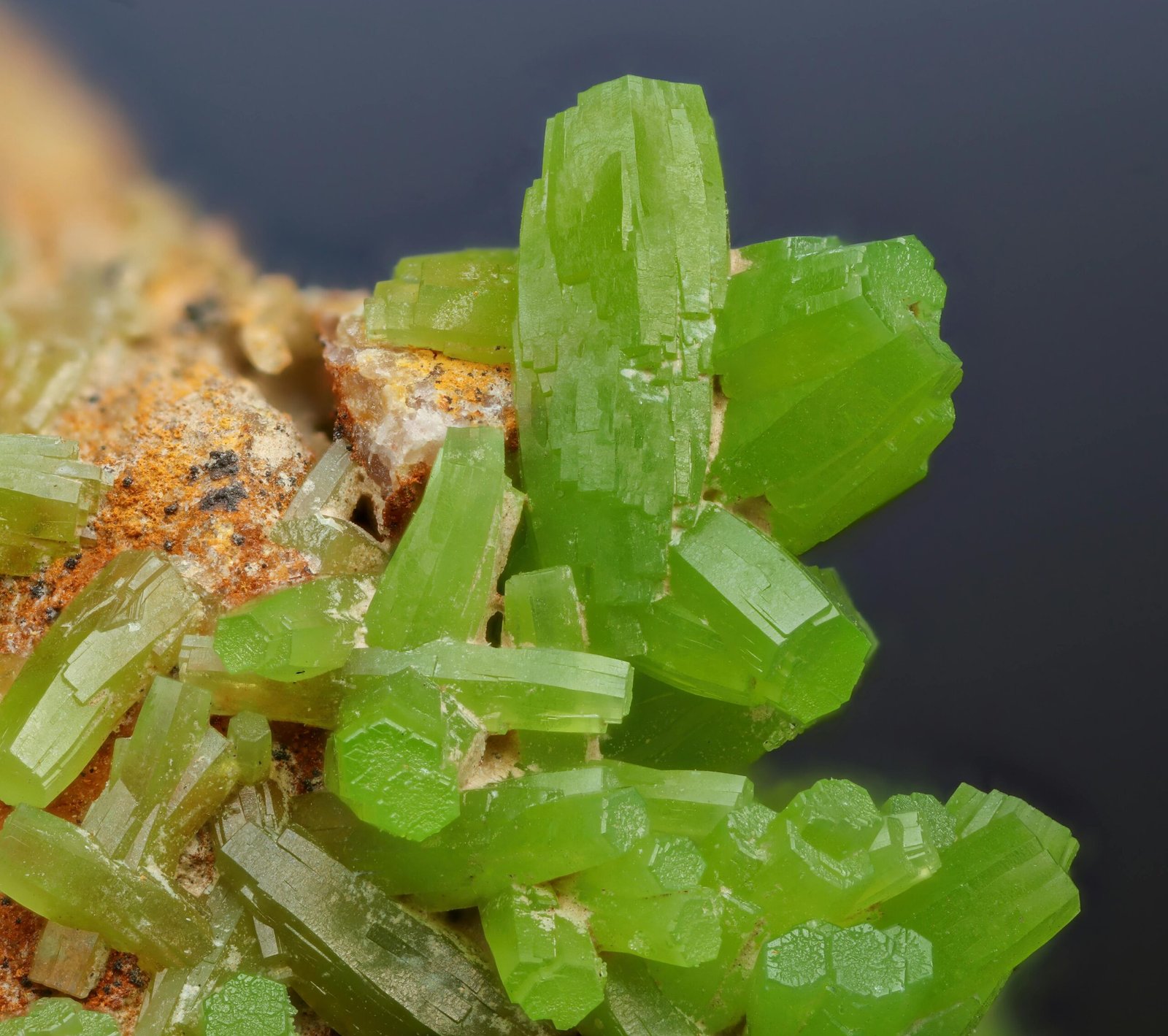
- Show crystal faces clearly. If your specimen has visible crystal faces, a close-up photograph showing the geometry and angles of those faces is the single most valuable image you can upload. Crystal habit is usually the most diagnostic property our AI uses.
- Photograph cleavage or fracture surfaces. If the specimen has a fresh break, photograph that surface in raking light. Flat, reflective cleavage planes look very different from the uneven or conchoidal fracture of other minerals — this distinction alone can confirm or rule out entire mineral groups.
- Use raking light for surface texture. A single light source at a low angle across the surface reveals surface texture, crystal striations, and botryoidal (grape-like) structure far more clearly than overhead flash or diffuse lighting.
- Include the matrix if present. The rock a mineral grew in tells you its geological environment. A mineral growing on granite matrix formed in very different conditions than one on limestone — this context eliminates many alternative identifications.
- Photograph any fluorescent response. If you have a UV light, photograph your specimen under short-wave and long-wave UV in a dark room and upload these alongside the daylight photos. UV response is immediately confirmatory for fluorite, calcite, scheelite, and several other species.
The single most helpful optional detail
The single most useful piece of information you can add in the context field — beyond photos — is where the specimen came from geologically. A mineral from a copper mining district almost certainly belongs to the copper ore mineral suite. A mineral from a pegmatite almost certainly belongs to the rare silicate or phosphate families. Geological provenance eliminates more alternative identifications faster than almost any other single piece of data.
Frequently Asked Questions
Have a Mineral to Identify?
Upload your photos above for an instant expert-level AI assessment — or explore our specialist identifier tools below.
Identify My Mineral ↑